What Makes a Painting a Masterpiece? Understanding Great Art
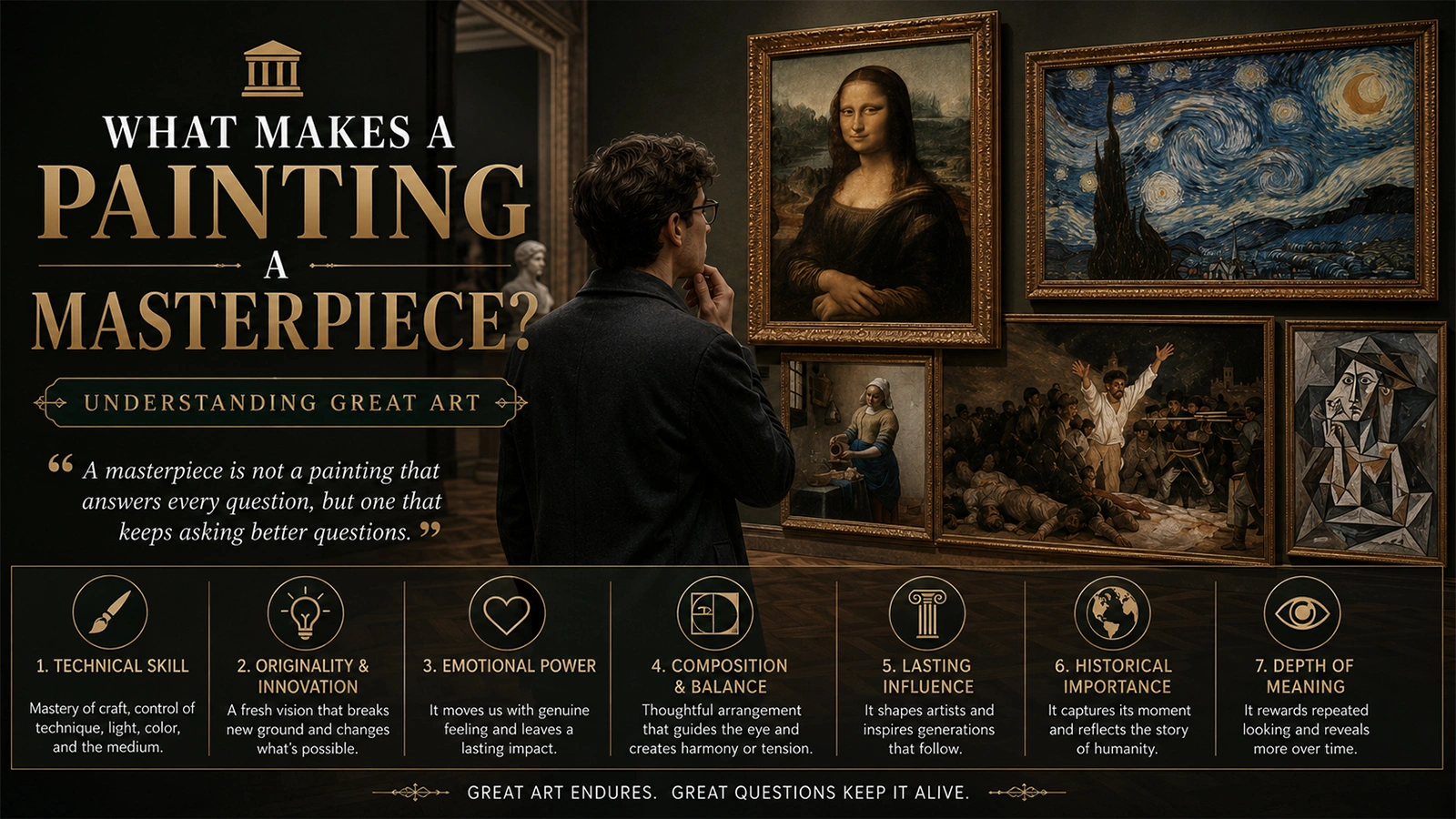
What makes a painting a masterpiece is a question that has occupied artists, critics, collectors, and everyday museum-goers for centuries. We instinctively sense that some works belong in a different category — that a canvas by Rembrandt or Vermeer carries a weight that a merely competent portrait does not. Yet pinning down the exact qualities that elevate great art from good art can feel slippery. Is it flawless technique? A revolutionary idea? Raw emotional force? The honest answer is that a true masterpiece usually unites several of these virtues at once, and learning to recognize them deepens the pleasure of looking at any painting.
This guide breaks down the defining qualities of enduring art in plain language, using real, well-documented examples. Whether you are a casual visitor or an aspiring collector, understanding art becomes far more rewarding once you know what to look for.
Why the Word “Masterpiece” Still Matters
The term originally had a literal meaning. In the medieval guild system, an apprentice produced a “master piece” to prove he had mastered his craft and could be admitted as a master in his own right. Over time the word shifted from a certificate of competence to a marker of exceptional, era-defining achievement. Today it describes a work that transcends its moment — a painting that continues to reward attention long after the culture that produced it has vanished.
Importantly, no single quality guarantees masterpiece status. A technically dazzling painting can still feel hollow, while a rough, unfinished sketch can pulse with life. The paintings we treasure most tend to score highly across multiple dimensions, and it is the combination that makes them unforgettable.
The Core Qualities of Great Paintings
Below are the qualities that critics and historians return to again and again when they discuss the qualities of great paintings. Think of them as overlapping lenses rather than a strict checklist.
1. Technical Skill
Mastery of craft is the foundation. This includes control of drawing, color, light, and the handling of the medium itself. When Jan van Eyck painted the Arnolfini Portrait in 1434, he pushed oil paint to render the sheen of brass, the softness of fur, and a convex mirror reflecting the whole room — a feat of observation and patience that still astonishes conservators.
Technique, however, is a means rather than an end. Diego Velázquez in Las Meninas used remarkably loose, almost abstract brushwork that resolves into breathtaking realism only when viewed from a distance. His skill lay not in fussy detail but in knowing exactly how much to suggest and how much to leave to the eye.
2. Originality and Innovation
Great art rarely repeats what came before. It introduces a new way of seeing. Originality can mean inventing a technique, breaking a rule, or framing a subject nobody had thought to frame. Claude Monet’s Impression, Sunrise looked so unfinished to 1874 critics that one of them coined the mocking term “Impressionism” — a label the movement proudly adopted. What seemed like carelessness was a deliberate attempt to capture fleeting light and atmosphere rather than fixed form.
Innovation also drives Pablo Picasso’s Les Demoiselles d’Avignon, which fractured the human figure into angular planes and helped launch Cubism. Originality gives a painting historical momentum: it changes what artists who follow believe is possible.
3. Emotional Power
A masterpiece moves us. Emotion is perhaps the least measurable quality, yet it is often the reason a painting lingers in memory. Francisco Goya’s The Third of May 1808 confronts the viewer with the terror of a man facing a firing squad, arms flung wide, and its raw humanity has made it a touchstone for anti-war imagery ever since.
Emotion need not be dramatic. The quiet, inward stillness of Johannes Vermeer’s domestic scenes generates a tenderness that many viewers find just as powerful as Goya’s horror. What matters is that the feeling is genuine and communicated through visual means rather than sentimental subject matter alone.
4. Composition and Balance
Composition is the architecture of a painting — how shapes, colors, and figures are arranged to guide the eye and create harmony or tension. Strong composition is often invisible; we feel its rightness without consciously analyzing it. Leonardo da Vinci’s The Last Supper organizes thirteen figures into balanced groups, with every perspective line converging on the head of Christ, so that structure itself carries the meaning of the scene.
Balance does not require symmetry. Many masterpieces use deliberate imbalance to create energy, placing a focal point off-center or letting a diagonal sweep across the canvas. Learning to trace these visual pathways is one of the most useful habits a viewer can develop, and our guide on how to read a painting walks through the process step by step.
5. Lasting Influence
Some paintings matter because of everything they made possible afterward. Influence is the ripple a work sends through later generations of artists. Caravaggio’s dramatic use of light and shadow, known as tenebrism, reshaped European painting for a century, inspiring artists from Spain to the Netherlands. A work with lasting influence keeps generating conversation, imitation, and reinterpretation.
6. Historical Importance
Closely related to influence is a painting’s place in the story of art and of humanity. Some works capture a pivotal cultural moment or embody the ideals of an entire age. Sandro Botticelli’s The Birth of Venus revived classical mythology in a Christian era and came to symbolize the Renaissance rediscovery of beauty and humanism. Historical importance can also attach to works that recorded events, challenged power, or gave voice to overlooked people.
The Marks of a Masterpiece at a Glance
When you stand in front of a painting and wonder whether it rises to greatness, these are the signals worth weighing:
- Technical command — the artist controls the medium with confidence and purpose.
- Originality — it offers a genuinely fresh vision rather than a familiar formula.
- Emotional resonance — it makes you feel something real and specific.
- Unified composition — every element supports the whole, nothing feels accidental.
- Depth of meaning — it rewards repeated looking and reveals more over time.
- Influence and legacy — it has shaped or continues to shape how others see.
- Historical resonance — it speaks to its moment and beyond it.
Very few paintings excel at all of these. But the more boxes a work quietly checks, the more likely it is to be called a masterpiece by future generations.
A masterpiece is not a painting that answers every question, but one that keeps asking better questions of everyone who stands before it. Its greatness lies less in perfection than in inexhaustibility — the sense that the canvas holds more than any single lifetime of looking could ever use up.
Taste, Time, and the Role of the Viewer
It is worth acknowledging that judgments about great art are not purely objective. Reputations rise and fall. Vermeer was largely forgotten for nearly two centuries before critics rediscovered him in the 1800s. Vincent van Gogh sold almost nothing in his lifetime yet is now among the most beloved painters in history. This should make us humble: the crowd’s verdict at any given moment is not the final word.
Time acts as a kind of filter. Works that continue to speak to new audiences, across different cultures and eras, tend to accumulate the consensus we call masterpiece status. Yet your own response matters too. Understanding art is a dialogue, not a test with a single correct answer. The frameworks above are tools to sharpen your looking, not rules to override what genuinely moves you.
Part of the joy is discovering the layers beneath the surface — the symbolism, biography, and secrets embedded in a canvas. Many celebrated works conceal deliberate puzzles, and our collection of famous paintings with hidden meanings and untold stories shows how much can hide in plain sight.
Frequently Asked Questions
Can a modern or abstract painting be a masterpiece?
Absolutely. Masterpiece status has nothing to do with realism or age. Abstract works such as those by Wassily Kandinsky or Mark Rothko are widely regarded as masterpieces because of their originality, emotional power, and lasting influence. The qualities that define great art — skill, innovation, feeling, and coherence — apply across every style and century.
Does a painting have to be famous to be a masterpiece?
Fame and greatness often overlap, but they are not the same thing. Many extraordinary paintings hang in regional museums and private collections without global recognition, while some famous works owe their status partly to marketing or scandal. A masterpiece earns its place through intrinsic quality; wide fame is a frequent consequence, not a requirement.
How can I learn to recognize great art myself?
Look often, and look slowly. Spend several minutes with a single painting instead of glancing at many. Notice where your eye travels, what you feel, and how the artist handled light and color. Reading about an artist’s intentions and context helps, but nothing replaces direct, patient observation. Over time your eye becomes more discerning almost without effort.
Conclusion: Keep Looking, Keep Learning
So, what makes a painting a masterpiece? Not one magic ingredient, but a rare convergence of technical skill, originality, emotional truth, thoughtful composition, and an influence that outlasts its creator. These works reward us precisely because they refuse to be exhausted — each visit reveals something new. The more you understand these qualities, the more every gallery becomes an adventure rather than a checklist.
At RGVM, we believe great art belongs to everyone willing to look closely. Come explore our galleries, spend time with the paintings that speak to you, and continue building your eye. For more guides on understanding and enjoying art, visit our blog and keep the conversation going.