Famous Paintings With Hidden Meanings and Untold Stories
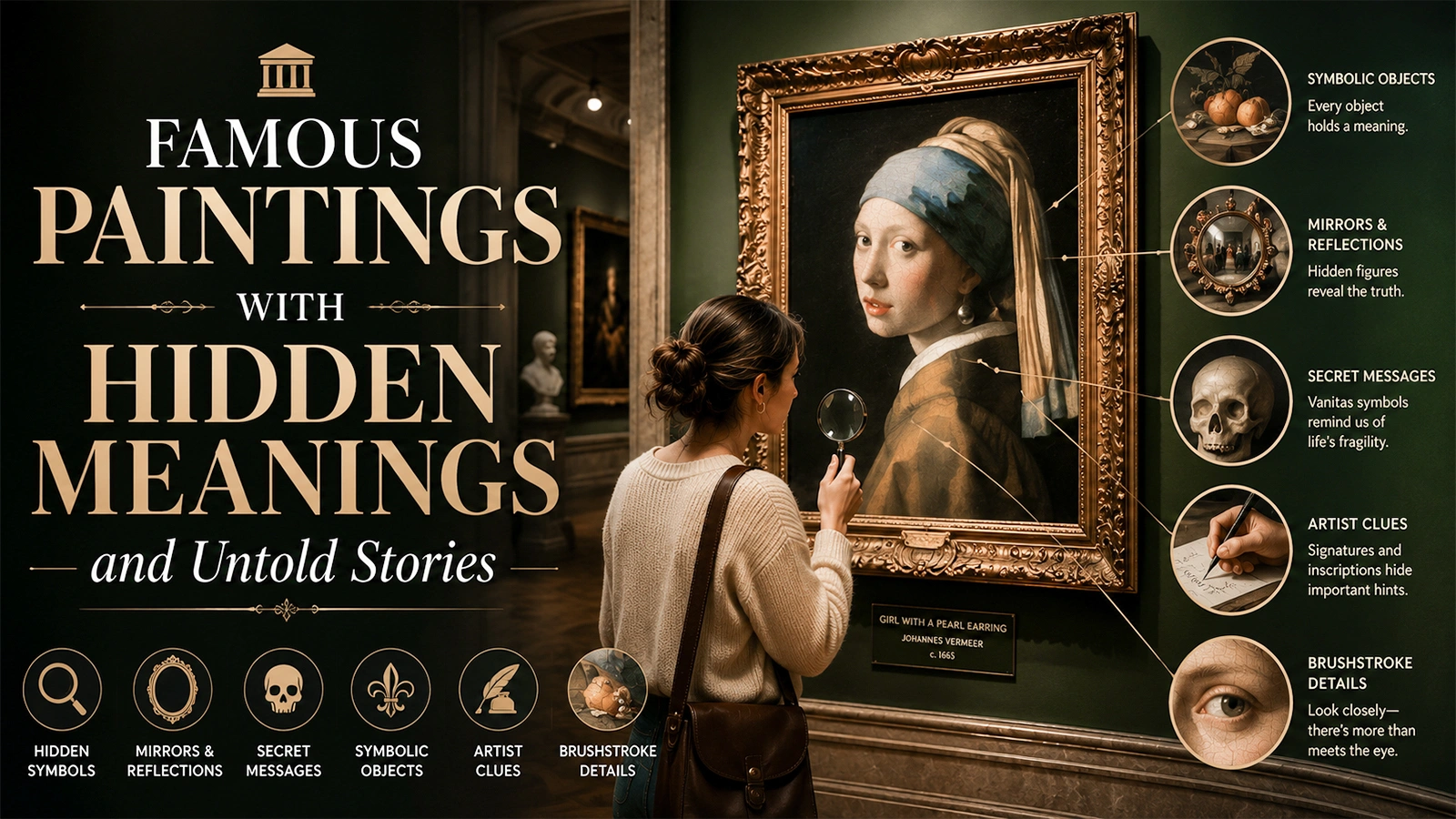
Famous paintings with hidden meanings have fascinated viewers for centuries, inviting us to lean closer to the canvas and ask what the artist was really trying to say. A great painting is rarely just a pretty surface. Beneath the varnish and brushstrokes lie coded messages, buried symbols, private jokes, and quiet confessions that only reveal themselves to the patient eye. This is the world of secrets in art, where a dog at a couple’s feet can mean loyalty, a skull can hover invisibly until you shift your gaze, and a bowl of fruit can whisper about death. In this article we will go decoding paintings that have kept their untold stories for hundreds of years.
Why Artists Hid Meaning in Plain Sight
For much of history, painting was a public language spoken to an audience that could not always read. Symbolism in paintings allowed artists to communicate ideas about faith, love, politics, and mortality without a single written word. A patron who commissioned a portrait wanted more than a likeness; they wanted their virtues, wealth, and beliefs woven into the composition. Meanwhile, artists themselves used hidden symbols to smuggle in personal opinions, sly humour, or dangerous ideas that could not be stated openly in an age of censorship and powerful churches.
Understanding this layered approach is central to appreciating what elevates certain works above others. If you want to explore that idea further, our guide to what makes a painting a masterpiece examines how meaning and technique combine to create lasting greatness.
The Many Forms of a Hidden Message
Not every secret is buried the same way. Before we look at individual works, it helps to know the main techniques artists used to conceal meaning. These are the tools of the trade for anyone serious about decoding paintings.
- Iconographic symbols — everyday objects with agreed-upon meanings, such as a lily for purity, a candle for the passage of time, or a dog for fidelity.
- Anamorphosis — a distorted image that only resolves into a recognisable shape when viewed from a specific angle, turning perspective itself into a puzzle.
- Hidden portraits and self-insertions — artists painting their own faces, or those of friends and enemies, into crowd scenes and religious gatherings.
- Coded texts and inscriptions — signatures, dates, and messages tucked into architecture, mirrors, or clothing.
- Underdrawings and pentimenti — earlier versions of a scene, revealed by modern imaging, that show how an artist changed their mind.
Masterpieces and Their Buried Secrets
With that vocabulary in hand, let us turn to some of the most famous paintings with hidden meanings in Western art. Each one rewards a second look.
The Mona Lisa and the Riddle of the Smile
Leonardo da Vinci’s portrait, painted in the early sixteenth century, owes much of its fame to a face that seems to change expression as you study it. This effect is not magic but technique: Leonardo’s mastery of sfumato, the soft blurring of edges around the mouth and eyes, leaves the exact expression ambiguous, so your own perception completes it. Beyond the smile, the dreamlike landscape behind the sitter does not quite line up on either side of her head, a subtle imbalance that adds to the sense of a figure suspended between worlds. Scholars still debate the sitter’s identity, most widely believed to be Lisa Gherardini, wife of a Florentine merchant, but the painting’s enduring power lies in how much it withholds.
The Last Supper and Its Gestures
Leonardo appears again with his mural of Christ and the apostles at the moment he announces that one of them will betray him. Rather than a static row of holy figures, Leonardo staged a psychological drama. The twelve apostles react in clusters of three, their hands and faces registering shock, denial, and suspicion. Judas is not separated by a halo or a caption, as in earlier tradition, but exposed by his body language: he recoils, clutching a small bag that hints at his payment, his face thrown into shadow. The genius of the work is that its meaning is carried almost entirely by gesture and grouping, a masterclass in symbolism in paintings without a single obvious label.
The Arnolfini Portrait and the Witness in the Mirror
Jan van Eyck’s 1434 double portrait of a couple in a richly furnished room is perhaps the most densely coded picture of the northern Renaissance. Almost every object carries weight. The small dog stands for fidelity, the single lit candle in the chandelier suggests the presence of God, the fruit on the windowsill hints at wealth or innocence, and the shoes cast aside may signal that the couple stand on holy ground. Most remarkable is the convex mirror on the back wall, which reflects not only the couple from behind but two additional figures standing where the viewer would be. Above it, van Eyck signed the wall with an unusually formal Latin inscription meaning “Jan van Eyck was here,” as though testifying as a witness to the scene. Whether the painting records a wedding, a betrothal, or something else remains debated, and that uncertainty is part of its lasting grip.
Botticelli’s Primavera and the Garden of Meaning
Painted in Florence around 1480, Botticelli’s Primavera is a lush allegory crowded with classical figures in an orange grove. Reading from right to left, the wind god Zephyrus seizes the nymph Chloris, who transforms into Flora, the flower-strewn goddess of spring. At the centre stands Venus, with the three Graces dancing beside her and Mercury dispersing clouds above. The painting is often interpreted as a Neoplatonic meditation on love ascending from earthly desire to divine beauty, a fashionable philosophy in the intellectual circles of its likely patrons, the Medici family. Botanists have identified hundreds of accurately rendered plant species scattered across the grass, turning the scene into a coded catalogue of spring itself.
Holbein’s The Ambassadors and the Anamorphic Skull
Hans Holbein the Younger’s 1533 portrait of two wealthy young men is a showcase of worldly success. Between them lies a shelf crowded with instruments of learning: globes, sundials, a lute, mathematical tools, and books. Yet stretched across the bottom of the picture is a strange grey smear that makes no sense from the front. Step to the side, or view it from a sharp angle, and the smear snaps into focus as a human skull. This anamorphic trick transforms a celebration of ambition into a solemn memento mori, a reminder that death waits beneath all earthly achievement. A small crucifix half-hidden behind a curtain in the upper corner deepens the spiritual message. Few paintings so completely change their meaning depending on where you stand.
Van Gogh and the Symbolism of a Troubled Heart
Vincent van Gogh rarely hid images the way earlier masters did, but his work is saturated with personal symbolism. He wrote in his letters about using colour to express emotion rather than to copy reality, and about the meanings he attached to recurring motifs. Sunflowers, which he painted in radiant series, stood for gratitude and a kind of devotional warmth. Wheatfields under turbulent skies expressed both the cycle of life and his own restlessness. Cypress trees, dark flames rising against the night, are often read as his private emblem of mortality. In works such as The Starry Night, the swirling sky may reflect his emotional turbulence as much as any real view, though we should treat such readings as thoughtful interpretation rather than proven fact.
A hidden meaning is not a lock waiting for the right key; it is a conversation the artist began and left unfinished, trusting that centuries of viewers would keep it going. The secret is not what the painter concealed, but the invitation to look longer than we usually do.
How to Read a Painting for Yourself
You do not need a doctorate to begin decoding paintings. Start by asking simple questions. What are the figures doing with their hands and eyes? Which objects seem oddly prominent for a casual scene? Is there a mirror, a window, or a reflection that shows more than it should? Does anything look distorted or out of place? These small observations are the doorway into art history stories that guidebooks often rush past.
It also helps to know the artist’s world. Symbols shift meaning across cultures and centuries, so a lily in a fifteenth-century altarpiece and a lily in a modern still life may say very different things. The painters who mastered these visual codes often reshaped what art could do, a theme we explore in our piece on artists who changed the history of painting forever. Reading their innovations alongside their symbolism reveals how technique and meaning grew together.
Frequently Asked Questions
Are hidden meanings in paintings always intentional?
Not always. Some symbols were deliberately placed by the artist and would have been instantly understood by contemporary viewers who shared the same visual language. Others are patterns we notice today that may or may not reflect the painter’s conscious intent. Responsible interpretation distinguishes between documented symbolism, such as the anamorphic skull in Holbein’s work, and modern speculation. When a reading cannot be confirmed by an artist’s writings, records, or established convention, it is best treated as a plausible theory rather than a fact.
How do experts uncover secrets in art that are not visible to the eye?
Conservators and researchers use technologies such as infrared reflectography, X-radiography, and ultraviolet light to see beneath the paint surface. These tools reveal underdrawings, earlier compositions the artist painted over, changes of mind known as pentimenti, and restorations added by later hands. Combined with archival research into contracts, letters, and inventories, this scientific detective work has transformed our understanding of many famous paintings with hidden meanings.
Do I need special training to appreciate symbolism in paintings?
No. Curiosity matters far more than credentials. Slowing down, looking closely, and asking why an artist made a particular choice will take you a long way. Reading a little about the period and the artist adds valuable context, but the most important skill is simply the willingness to look longer and let the painting speak.
Keep Exploring the Stories Behind the Canvas
The next time you stand before a masterpiece, remember that the surface is only the beginning. Famous paintings with hidden meanings reward the viewer who lingers, questions, and imagines the person who once stood at the easel with a secret to keep. Every dog, mirror, candle, and shadow may be a door into a larger story waiting to be opened. At RGVM we believe great art is meant to be decoded together, one detail at a time. Continue your journey through more art history stories and untold stories on our blog, and let each visit teach your eye to see a little more than it did before.