The Most Beautiful Museum Buildings Around the World
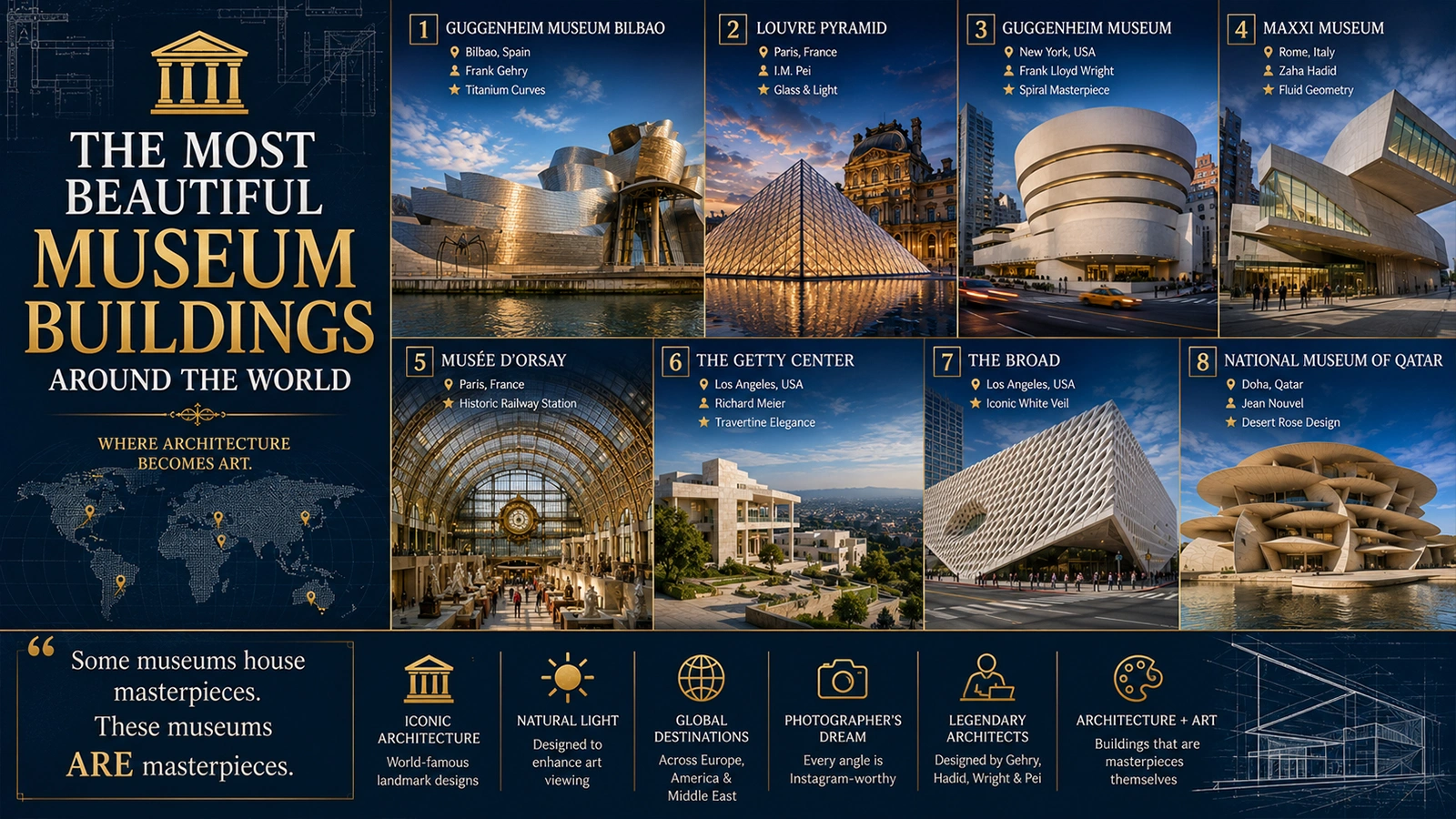
Some of the most beautiful museum buildings in the world are works of art in their own right, rivalling the masterpieces displayed within their walls. Long before you reach a single canvas or sculpture, the structure itself begins the conversation — its curves, its light, its silhouette against the sky. Great museum architecture does not merely house culture; it stages an experience, transforming an ordinary visit into a pilgrimage. Across continents, visionary architects have used steel, stone, glass, and titanium to create landmark buildings that draw millions of travellers each year. In this guide we journey through a collection of iconic museums whose design deserves as much admiration as the collections they protect.
Why Museum Architecture Matters
A museum is one of the few building types where a society openly declares what it treasures. That ambition invites bold architectural design. When a city commissions a new gallery, it is rarely satisfied with a plain box; it wants a statement, a symbol, a place that will still feel extraordinary a century from now. The result is that stunning art museums frequently become the defining silhouette of their skylines, more recognisable than the government buildings or corporate towers nearby.
The best designs balance two competing demands. On one hand, galleries need calm, controlled, well-lit interiors so that paintings and objects can be seen honestly. On the other, the exterior often strives to astonish. The genius of a great museum architect lies in reconciling these opposites — drama outside, serenity inside.
- Light — natural daylight, carefully filtered, remains the single most important element in showing art at its truest.
- Circulation — the path a visitor takes should feel intuitive, unhurried, and full of discovery.
- Materials — the honest use of stone, glass, concrete, or metal gives a building its emotional temperature.
- Context — the finest museums respond to their city, climate, and landscape rather than ignoring them.
- Scale — grand enough to inspire awe, human enough to feel welcoming.
Sculptural Icons of the Modern Age
The Guggenheim Museum Bilbao, Spain (Frank Gehry)
Perhaps no single building has done more to prove that architecture can transform a city's fortunes. Frank Gehry's titanium-clad museum, completed in 1997, rises from the banks of the Nervión River like a shimmering cluster of ship sails and fish scales. Its swirling, non-rectilinear forms were made possible by aerospace design software, allowing curves that seem impossible in solid metal. The titanium panels catch and change with the light, glowing gold at sunset and silver under cloud. Inside, a soaring central atrium organises the galleries around a flood of daylight. The building sparked the phrase “the Bilbao effect,” describing how a single work of architecture can revive an entire region.
The Guggenheim Museum, New York, USA (Frank Lloyd Wright)
Decades before Bilbao, Frank Lloyd Wright reinvented what a gallery could be. Opened in 1959, his New York Guggenheim replaces the traditional sequence of rooms with a single continuous spiral ramp coiling upward beneath a domed skylight. Visitors ascend by elevator and then drift gently downward, viewing art along the way in one uninterrupted gesture. The smooth white exterior, widening as it rises, was radical and controversial in its Manhattan setting. Today it stands as one of the purest expressions of the idea that a museum's form and its function can be one and the same.
MAXXI, Rome, Italy (Zaha Hadid)
Zaha Hadid's National Museum of 21st Century Arts, completed in 2010, brings her signature fluid geometry to the ancient city of Rome. Rather than a set of static rooms, MAXXI reads as a system of flowing concrete tubes that bend, overlap, and cantilever through and over one another. Sinuous black staircases seem to hang in mid-air, and long ribbons of glazed roof pour daylight down the curving walls. The building refuses right angles almost entirely, choreographing movement as if the visitor were caught in a slow current. It remains one of the most compelling arguments that architectural design can itself be a form of contemporary art.
Reinvention, Light, and the Landscape
The Louvre Pyramid, Paris, France (I. M. Pei)
When I. M. Pei proposed placing a modern glass pyramid in the historic courtyard of the Louvre, the reaction in Paris was fierce. Completed in 1989, the pyramid has since become one of the most beloved landmark buildings in the world. Its clean geometry of glass and slender steel offers a deliberate contrast to the ornate palace surrounding it, and its transparency allows the old facades to remain fully visible. Below ground, the pyramid floods a vast new entrance hall with daylight, solving the practical problem of moving millions of visitors while creating a luminous, unforgettable arrival.
The Musée d'Orsay, Paris, France
Few museums tell their own story as vividly as the Musée d'Orsay, housed in a former railway station on the Seine. Built for the 1900 World's Fair, the Gare d'Orsay was nearly demolished before being reborn as a museum in 1986. Its magnificent Beaux-Arts hall, with an arched glass roof and the great station clock still keeping time, now shelters the world's finest collection of Impressionist painting. The vast, light-filled nave that once welcomed trains is a perfect example of how thoughtful reinvention can preserve an iconic structure while giving it entirely new life.
The Getty Center, Los Angeles, USA (Richard Meier)
Perched on a hilltop above Los Angeles, Richard Meier's Getty Center, opened in 1997, is a serene composition of pavilions clad in warm travertine stone and gleaming white metal. A cable-drawn tram carries visitors up from the valley, heightening the sense of arrival at a modern acropolis. Meier orchestrated the buildings around courtyards, gardens, and framed views of the Pacific and the city beyond. Skylights and clerestories filter the famous California sunshine into the galleries, and the rough-cut travertine — some blocks bearing fossils — grounds the crisp geometry in something ancient and tactile.
The Broad, Los Angeles, USA (Diller Scofidio + Renfro)
Also in Los Angeles, The Broad, which opened in 2015, wraps its contemporary art collection in a striking white lattice its designers call the “veil.” This honeycombed exterior shell lifts and folds to form the entrance, while filtering soft, even daylight into the top-floor galleries below. Beneath the veil sits the “vault,” a solid concrete volume that stores the collection and whose curving underside shapes the lobby. The interplay of porous veil and dense vault gives the building a memorable identity on Grand Avenue and demonstrates how structure and storage can become architectural drama.
The National Museum of Qatar, Doha (Jean Nouvel)
Jean Nouvel drew inspiration from a natural wonder of the desert for the National Museum of Qatar, completed in 2019. Its extraordinary form is composed of hundreds of vast interlocking discs, echoing the crystalline structure of the “desert rose” — mineral formations that grow in arid, sandy ground. The sand-coloured discs cantilever, tilt, and intersect to create sheltering canopies and dramatic interior voids, with almost no straight wall or standard floor plate anywhere in the building. The design fuses cutting-edge engineering with a deeply local symbol, proving that a museum can express the identity of a nation through architecture alone.
The greatest museum buildings understand that awe begins at the threshold. By the time a visitor reaches the first painting, the architecture has already taught them how to look — slowly, generously, and with wonder.
What These Buildings Have in Common
Travel from Bilbao to Doha and the styles could hardly be more different, yet a shared philosophy links these iconic museums. Each one treats the act of visiting as a journey to be shaped, not a chore to be processed. Each uses daylight as a primary building material. And each is unmistakably rooted in its place — the titanium curves born of an industrial river city, the desert rose rising from the sands, the railway hall preserved beside the Seine. For anyone planning a cultural trip, these structures are reason enough to build an itinerary around them. If you love discovering cities through their galleries, you may enjoy our guide to the best cities around the world for art lovers, where architecture and collections meet.
Frequently Asked Questions
What is considered the most beautiful museum building in the world?
Beauty is subjective, but the Guggenheim Museum Bilbao is the title most frequently mentioned. Its rippling titanium forms redefined what a museum could look like and inspired countless projects that followed. That said, admirers of classical elegance often champion the Musée d'Orsay, while lovers of pure modern geometry point to the Louvre pyramid. The most beautiful choice ultimately depends on whether you are moved by sculptural drama, historic grandeur, or minimalist clarity.
Does the architecture of a museum affect the art inside?
Absolutely. Architecture controls how art is lit, framed, and encountered. Well-designed galleries use filtered daylight and calm proportions so that colours read truthfully and works can breathe. A building's circulation also sets the rhythm of a visit, deciding whether you rush past pieces or linger. Great museum architecture works quietly in service of the collection, even when its exterior is spectacular.
Which architects are most famous for designing museums?
Several names appear again and again in any discussion of stunning art museums. Frank Gehry, Frank Lloyd Wright, I. M. Pei, Zaha Hadid, Richard Meier, and Jean Nouvel have each shaped how we think about cultural buildings. Their work spans the sculptural, the geometric, and the deeply site-specific, and together they demonstrate the astonishing range that architectural design can achieve within a single building type.
Plan Your Own Architectural Pilgrimage
The most beautiful museum buildings reward travellers who look up, walk slowly, and let the structure set the mood before the art takes over. Whether you are drawn to Gehry's shimmering curves, Hadid's flowing concrete, or the reinvented grandeur of an old railway station, these landmark buildings prove that great architecture and great art belong together. Choose one that stirs your imagination and let it anchor your next journey. To understand why the experience is so worthwhile, read our reflection on why every traveler should visit an art museum, and explore more travel and design stories on our blog. Your next great museum awaits — and the building itself may become the most memorable part of the trip.