Best Cities Around the World for Art Lovers
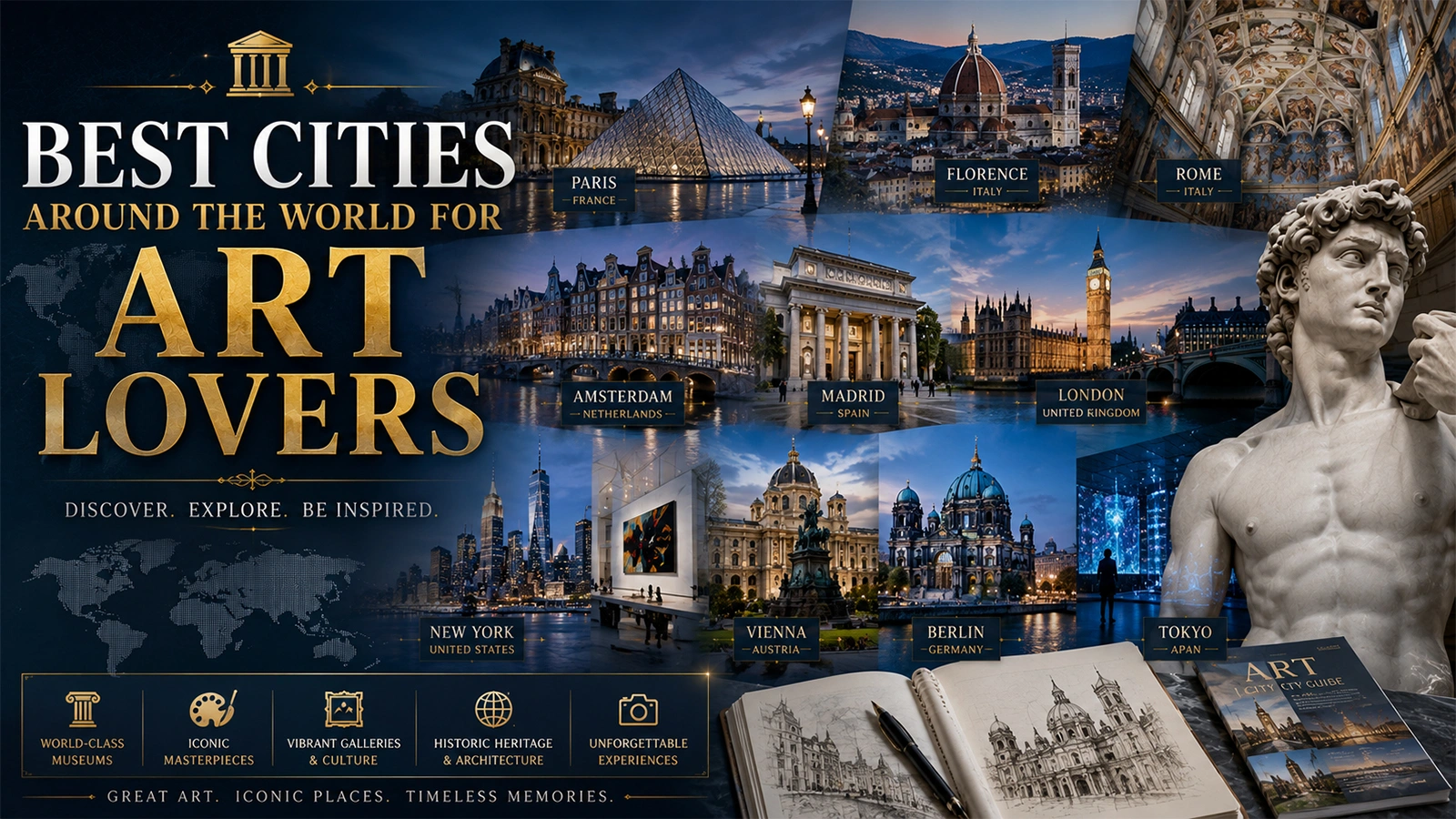
For anyone who plans their travels around masterpieces rather than beaches, the best cities for art lovers are less like destinations and more like open-air textbooks, where a single afternoon can carry you from a Renaissance altarpiece to a splash of contemporary neon. Great art cities do not simply house famous paintings; they weave creativity into their streets, cafes, and skylines until the whole place feels like one continuous gallery. If you crave cultural travel that leaves you changed, this guide walks you through the museum cities and art travel destinations worth building an entire trip around.
What Makes a City Great for Art Lovers
Not every city with a big museum earns a spot on a serious art itinerary. The most rewarding art cities share a certain density and diversity: world-class collections within walking distance of independent galleries, public sculpture that surprises you on an ordinary corner, and a living art scene that keeps producing new work rather than only preserving the old. The finest art travel destinations reward both the checklist tourist and the slow wanderer, offering blockbuster names alongside quiet rooms where you can sit alone with a single canvas.
Below are ten cities that consistently top the wish lists of curators, students, and casual gallery-goers alike. Each brings something distinct to the table, from centuries of patronage to a raw, experimental edge.
The World’s Essential Art Cities
Paris, France
Paris remains the reference point against which other museum cities are measured. The Louvre alone could occupy days, its galleries stretching from ancient antiquities to the enigmatic gaze of the Mona Lisa. Yet the city’s true magic lies in its range: the Musée d’Orsay gathers Impressionism under a former railway roof, the Centre Pompidou champions the modern and the provocative, and the Musée de l’Orangerie wraps you inside Monet’s vast water lilies. Between visits, the Marais district hums with independent galleries, making Paris a place where fine art and daily life are inseparable.
Florence, Italy
No city distills the Renaissance quite like Florence. The Uffizi Gallery is a pilgrimage in itself, hanging Botticelli’s Birth of Venus and Primavera in rooms that once belonged to the Medici. Walk a few minutes to the Galleria dell’Accademia and you meet Michelangelo’s David face to face, luminous under his purpose-built dome. Florence teaches you that art and architecture grew up together here, so even the streets, chapels, and bridges feel curated.
Rome, Italy
Rome layers antiquity, Baroque drama, and sacred grandeur into one unforgettable art scene. The Vatican Museums culminate in the Sistine Chapel, where Michelangelo’s ceiling still stops visitors mid-sentence. The Galleria Borghese holds Bernini’s sculptures, marble somehow softened into flesh, while Caravaggio’s canvases wait in ordinary churches, free to anyone who steps inside. In Rome, masterpieces are not locked away; they are part of the city’s living fabric.
Amsterdam, Netherlands
Amsterdam pairs Golden Age brilliance with an easygoing, canal-side charm. The Rijksmuseum showcases Rembrandt’s monumental Night Watch and Vermeer’s quiet interiors, while the Van Gogh Museum traces one turbulent life through the richest collection of his work anywhere. Add the Stedelijk for modern and contemporary art, and you have a compact trio that makes Amsterdam one of the most efficient art travel destinations in Europe.
Madrid, Spain
Madrid’s “Golden Triangle of Art” is a gift to anyone short on time. The Prado holds Velázquez’s Las Meninas and Goya’s haunting black paintings; the Reina Sofía guards Picasso’s Guernica, a canvas that still radiates political grief; and the Thyssen-Bornemisza fills the historical gaps with centuries of European painting. Three great museums stand within a short stroll of one another, framed by leafy boulevards.
London, United Kingdom
London’s art scene is vast and, refreshingly, often free. The National Gallery offers a sweeping survey of Western painting, Tate Britain celebrates Turner’s stormy skies, and Tate Modern reinvented a power station into a cathedral of contemporary art. Beyond the giants, neighborhoods like Shoreditch and Mayfair overflow with commercial galleries, ensuring the city always feels current.
New York City, United States
New York is where the twentieth century learned to paint boldly. The Metropolitan Museum of Art spans five thousand years of human creativity, while the Museum of Modern Art holds touchstones like Van Gogh’s Starry Night and Picasso’s Les Demoiselles d’Avignon. Frank Lloyd Wright’s spiraling Guggenheim and the gallery-packed streets of Chelsea keep the city’s art scene restless and forward-looking.
Vienna, Austria
Vienna wears its imperial elegance proudly. The Kunsthistorisches Museum houses one of the world’s finest old-master collections, and the Belvedere is home to Gustav Klimt’s shimmering The Kiss. The Leopold Museum deepens the story with Egon Schiele’s restless portraits. Vienna is a city where coffeehouse culture and gilded galleries make cultural travel feel indulgent in the best way.
Berlin, Germany
Berlin offers art with a harder, more experimental edge. Museum Island, a UNESCO World Heritage site, gathers five monumental institutions, including the Pergamon and its reconstructed ancient architecture. Yet Berlin’s energy also lives in its street art, its former factories turned exhibition spaces, and its embrace of the raw and unfinished. Few cities balance historical weight and contemporary risk so vividly.
Tokyo, Japan
Tokyo proves that the greatest art cities are not confined to Europe and America. The Tokyo National Museum preserves centuries of Japanese painting, calligraphy, and craft, while the Mori Art Museum and teamLab’s immersive digital worlds push art into new dimensions. Tokyo blends reverence for tradition with a fearless appetite for the future, making it one of the most exciting art travel destinations today.
How to Plan an Art-Focused City Trip
A little preparation transforms a good art trip into an unforgettable one. Museums are demanding on the feet and the attention, so pacing matters as much as ambition. Keep these tips in mind as you plan your route through the world’s museum cities.
- Book timed tickets in advance. The most famous galleries sell out, and pre-booking spares you hours in line at the Uffizi, the Vatican, or the Van Gogh Museum.
- Prioritize before you arrive. Choose five to ten works you must see in each museum so you leave satisfied even if fatigue sets in early.
- Visit early or late. The first hour after opening and the final hour before closing are the quietest, giving you space to breathe in front of the masterpieces.
- Mix big institutions with small galleries. Balancing blockbuster museums with intimate independent spaces keeps your eye fresh and reveals a city’s living art scene.
- Look for free days and city passes. Many museums offer discounted or free entry on certain evenings, and multi-museum passes often pay for themselves quickly.
- Leave room to wander. Some of the best art in these cities is public, from Rome’s fountains to Berlin’s murals, so build in unstructured time to discover it.
The finest art cities are not measured by how many masterpieces they contain, but by how completely they let art spill out of the frame and into ordinary life — a fresco glimpsed through a church door, a sculpture shading a public square, a gallery tucked behind a bakery. To travel for art is to learn a city’s deepest way of seeing.
Beyond the Big Ten
While these ten cities anchor most art itineraries, the world holds countless rising and underrated destinations. St. Petersburg’s Hermitage rivals the Louvre in scale; Mexico City honors Frida Kahlo and Diego Rivera in vivid color; Bilbao reinvented itself around Frank Gehry’s Guggenheim; and Chicago, Los Angeles, and Venice each offer museum-rich escapes for the dedicated traveler. The beauty of cultural travel is that the map keeps expanding, and every art lover eventually finds a city that feels like a personal discovery.
Frequently Asked Questions
Which city is best for a first-time art traveler?
Paris is often the ideal starting point because it combines unrivaled variety with walkable neighborhoods. In a few days you can experience ancient art, Renaissance masterpieces, Impressionism, and cutting-edge contemporary work, all within an inspiring, easily navigated city. Madrid and Amsterdam are also excellent for beginners thanks to their compact clusters of world-class museums.
How many days should I spend in a major art city?
Plan on at least three full days for a top-tier art city, and more if you want to explore beyond the flagship museums. Two or three days let you cover the essential collections without exhaustion, while leaving time for smaller galleries and unhurried wandering. Trying to conquer a city like Paris or London in a single day almost always leads to burnout.
Are museum passes worth buying?
For most art-focused trips, yes. City museum passes frequently include skip-the-line access and cover several institutions at a lower combined price than individual tickets. If you intend to visit three or more museums, a pass usually saves both money and time. Always check what is included, since a handful of major sites occasionally require separate reservations.
Start Planning Your Art Pilgrimage
The best cities for art lovers are waiting to be explored, each offering its own dialogue between history, beauty, and imagination. Whether you are drawn to the gilded rooms of Vienna, the raw energy of Berlin, or the Renaissance glow of Florence, the perfect art journey begins with a single decision to go. Let curiosity be your compass and the world’s galleries become your itinerary.
Ready to dig deeper before you pack your bags? Explore A Traveler’s Guide to the World’s Most Famous Painting Museums to map out the collections you cannot miss, and discover The Most Beautiful Museum Buildings Around the World for destinations where the architecture is a masterpiece in its own right. For more inspiration on art, travel, and creativity, browse the rest of our RGVM blog and let your next great adventure take shape.