
UNESCO World Heritage City Jaipur: How Ancient Town Planning Shaped Modern Artistic Expression
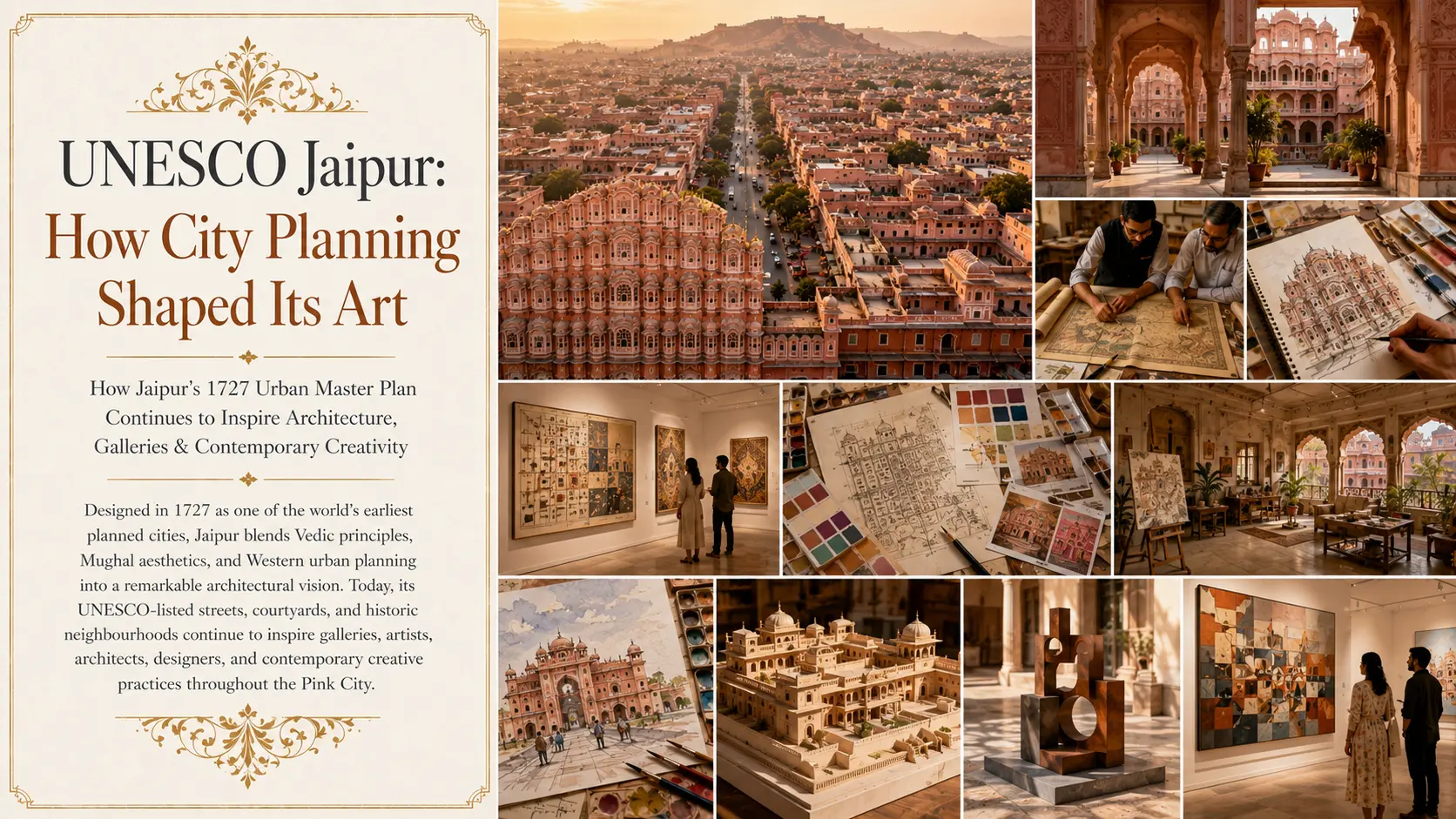
Few cities in the world wear their history quite so openly as Jaipur. To walk through its terracotta-rose streets is to read an idea made visible: a deliberate, mathematically considered vision of how human life, commerce, and beauty might be arranged in harmony. When the historic walled city was inscribed as a UNESCO Jaipur World Heritage Site in 2019, it confirmed what residents and travellers had long sensed — that the so-called pink city is not merely picturesque but profoundly intentional, a masterwork of urban design whose principles still ripple through the way art is made and experienced here today.
Founded in 1727 by the scholar-king Sawai Jai Singh II, Jaipur was among the earliest planned cities of its era in the subcontinent. Its grid of wide avenues, ordered sectors, and rhythmic bazaars was no accident of growth but a composition. For the collectors and culture enthusiasts who are drawn to Rajasthan, understanding this design is a way of understanding the visual language of the region itself — a language of symmetry, scale, and colour that continues to shape contemporary galleries and creative spaces.
The Vision Behind the Grid: Jaipur City Planning as an Artistic Act
Sawai Jai Singh II was an astronomer and a patron of learning as much as a ruler, and his approach to Jaipur city planning reflected that breadth of mind. Rather than allowing the new capital to sprawl organically, he commissioned a city laid out on a grid — a structure of straight, broad streets crossing at right angles to define a series of rectangular blocks. These wide thoroughfares were lined with continuous bazaars, creating commercial arteries that were also generous public spaces.
The plan organised the city into rectangular sectors known as chowkris. This sectoring gave Jaipur a legibility unusual for its time: each quarter had its own character and function, yet all were bound together by a shared geometry and a unifying scale. The result was a city that could be read almost like a manuscript — orderly, proportioned, and composed with an eye for both utility and grandeur.
To plan a city on a grid is to make an argument about order — a belief that beauty and daily life can be measured, balanced, and arranged in deliberate proportion.
Vedic Architecture and the Spiritual Geometry of the Walled City
What distinguishes Jaipur from a purely functional grid is the way its plan was interpreted in light of ancient Indian architectural thought. The layout drew on principles associated with Vedic architecture and the Shilpa Shastra tradition — bodies of knowledge concerned with the auspicious arrangement of space, the orientation of structures, and the relationship between the built environment and a larger cosmic order.
In this tradition, a city is not simply a container for people but a kind of diagram of harmony. The sectors, the alignment of streets, and the placement of important structures were understood to carry meaning beyond convenience. The walled city, ringed by fortified gates, became a contained and ordered world, its geometry an expression of balance.
An Exchange of Cultures
Crucially, Jaipur's design is not a single tradition rendered in stone but a conversation between several. The city reflects an exchange of ideas among ancient Hindu thought, Mughal aesthetics, and emerging Western notions of urban planning. This synthesis is precisely what UNESCO recognised: a living example of how cultures meet, borrow, and create something new. For artists, this layered inheritance is fertile ground — a reminder that originality often grows from dialogue rather than isolation.
The Pink City: Colour as a Unifying Language
Perhaps no feature of Jaipur is more famous than its colour. The warm rose-pink wash that gives the pink city its name unifies the historic core into a single visual field, softening the hard logic of the grid with a glow that shifts beautifully through the day. The colour does for the eye what the plan does for the foot: it binds disparate buildings, bazaars, and facades into one coherent composition.
This idea — that a whole environment can be treated as a single artwork — is a powerful inheritance for anyone who creates or curates today. The lessons of Jaipur's colour-unified fabric can be distilled into a few enduring principles:
- Coherence over spectacle: a restrained, shared palette can be more striking than a clamour of competing tones.
- Light as a material: colour was chosen to live and change with the Rajasthani sun, not to sit fixed and flat.
- The public realm as canvas: beauty was applied to streets and facades, treating the city as everyone's gallery.
- Scale and rhythm: repeated forms and proportions create a sense of order that the eye finds calming and the memory holds.
How Heritage Art Shapes Modern Artistic Expression
The genius of Jaipur's old design is that it never stayed confined to the past. Its grammar — symmetry, courtyards, ordered sectors, and a unifying palette — continues to inform how contemporary creative spaces are imagined throughout the city. This is the living thread of heritage art: not nostalgia, but a vocabulary that each generation reinterprets.
Courtyards, Symmetry, and the Modern Gallery
The traditional haveli courtyard — an open, light-filled centre around which rooms are arranged — has become a favoured template for galleries and cultural venues. Many of Jaipur's most compelling contemporary art spaces inhabit restored historic buildings, allowing visitors to move through art as one moves through the old city: along clear axes, into hushed interiors, and out again into sunlit courts. The architecture itself becomes part of the curatorial experience.
Public Art and the Logic of the Chowkri
The same sectoring logic that organised the chowkris informs how festivals, installations, and public art are staged in Jaipur. Wide bazaar streets become processional routes; gateways frame works of art as they once framed travellers; and the human scale of the original plan keeps even ambitious installations approachable. Contemporary creators working here inherit a stage that was, in a sense, designed centuries ago.
For the painters and miniaturists whose work draws on Rajasthani tradition, the influence runs deeper still. The precision, ordered composition, and jewel-like colour of the region's painting share a sensibility with the city that surrounds them. To collect such work is, in part, to hold a fragment of this larger design philosophy in one's own home.
A Living Heritage
Jaipur endures as a rare and instructive example of a city conceived as a single artistic statement — its grid, its sectors, its gates, and its famous colour all working toward a vision of ordered beauty. The 2019 UNESCO inscription was not an ending but an invitation: to look again, more closely, at how the past continues to shape the present. The way galleries are designed, the way installations occupy the streets, the way a painting carries the rhythm of its homeland — all of it traces back to the deliberate geometry of the eighteenth-century plan.
To appreciate Indian and Rajasthani art is to listen for these echoes of place and tradition within each work. If Jaipur's heritage has stirred your own curiosity, you may find that exploring the paintings and stories gathered at RGV Museum offers a quiet, rewarding way to carry a piece of that enduring artistry with you.