
The Walled City Bazaars of Jaipur: Where Centuries-Old Artisan Traditions Still Thrive
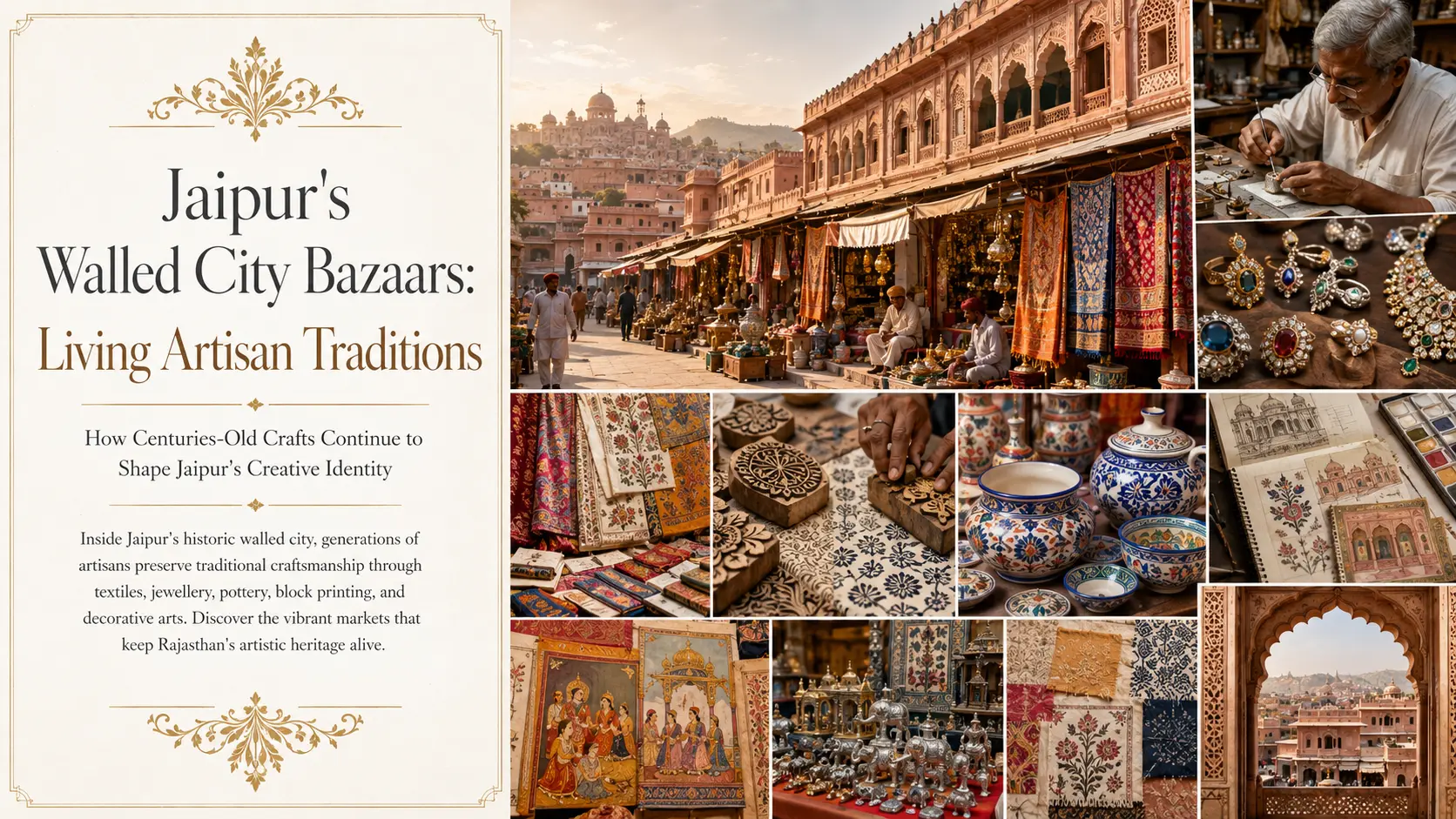
Step through any of the historic gateways into the walled city Jaipur and time seems to fold in on itself. The terracotta-pink facades that give the Pink City its name stretch in unbroken arcades, and beneath them unfold the jaipur bazaars — among the liveliest and most colourful market streets anywhere in India. Here, the rhythm of commerce has barely changed in two centuries. Goldsmiths bend over enamelled trays, block-printers stamp lengths of cotton with carved wooden blocks, and the air carries the mingled scent of marigolds, spices, and freshly dyed cloth.
These markets are far more than shopping destinations. They are living archives of rajasthani handicrafts, where craft knowledge passes from one generation to the next inside the same narrow lanes that have sheltered it for hundreds of years. To wander them is to witness handmade art in continuous practice — not preserved behind glass, but made, sold, and used in daily life. This is the story of those bazaars, the artisan traditions they sustain, and why they matter to anyone who loves Indian craft.
A City Built for Commerce and Craft
Jaipur was founded in the early eighteenth century by Maharaja Sawai Jai Singh II, and unlike most cities that grow by accident, it was planned with deliberate geometry. Its grid of broad streets and rectangular blocks was laid out to serve both trade and craft, with distinct quarters historically associated with particular communities of makers. That planning still shapes how the bazaars function today: each major market tends to specialise, so a buyer knows roughly where to find jewellery, where to find textiles, and where to find brass and lacquer work.
The result is a remarkably legible city of commerce. Behind the uniform pink arcades lie workshops, courtyards, and family homes where the actual making happens — often only a few steps from the stall where the finished piece is sold. This closeness of workshop and marketplace is precisely what keeps the artisan traditions alive and visible.
The Major Bazaars of the Old City
Each of the principal markets within the walled city has its own character and speciality. While the boundaries blur and goods of every kind spill across them, a few names stand out for collectors and visitors alike.
- Johari Bazaar — the historic jewellery market, famous for kundan (gem-setting in refined gold) and meenakari (vivid enamel work). This is where Jaipur's reputation as a centre of fine jewellery was forged.
- Bapu Bazaar — a destination for indian textiles, block-printed fabrics, quilts, and the soft, embroidered leather slippers known as mojari or jutti.
- Tripolia Bazaar — known for colourful lac bangles and brassware, with workshops that still shape and lacquer bangles by hand.
- Kishanpol and Chandpol Bazaars — strongholds of hand block printing, textiles, and a wide range of general handicrafts.
Together these streets form an open-air gallery of rajasthani handicrafts, where the act of buying is inseparable from watching the work being done.
Living Artisan Traditions and Their Techniques
What distinguishes the bazaars of the Pink City is that so many of their crafts are still practised by hand, using methods refined over generations. These are not reproductions assembled for tourists; they are living disciplines.
Meenakari and Kundan Jewellery
The jewellery traditions of Jaipur are among the most celebrated in India. Meenakari is the art of fusing coloured enamel onto metal, producing the jewel-bright reds, greens, and whites that decorate the reverse of many pieces. Kundan is the complementary technique of setting gemstones into pure gold foil. The two are often combined in a single ornament, with the enamelled back as carefully finished as the gem-set front — a quiet point of pride among master jewellers.
Hand Block Printing
The textiles of the region carry one of India's most recognisable craft signatures. Around Jaipur, two block-printing traditions are especially associated with the area:
- Sanganeri printing — fine, delicate floral motifs printed in clear colours on a pale ground, prized for its precision.
- Bagru printing — bolder, earthier patterns often built on natural dyes and a characteristic darker background.
Both rely on hand-carved wooden blocks pressed in careful registration across the cloth, a process demanding patience and an unerring eye. The repetition is hypnotic; the smallest misalignment shows.
Blue Pottery, Lac and Leatherwork
Beyond jewellery and cloth, the bazaars sustain a wider constellation of crafts. Jaipur's distinctive blue pottery — a low-fired glazed ware in cobalt, turquoise, and white — is sold throughout the old city. Lac is worked into the bright bangles of Tripolia, and supple leather is tooled and embroidered into the mojari footwear that fills Bapu Bazaar. Each craft has its own tools, vocabulary, and lineage of makers.
The Economics and Challenges of Craft Today
For all their vibrancy, the markets and their makers face real pressures. Understanding them helps explain why thoughtful patronage matters.
- Competition from machine-made goods. Mass-produced imitations can undercut genuine handwork on price, making it harder for artisans to earn a fair return on the time their craft demands.
- Generational continuity. As younger family members weigh other careers, some workshops struggle to pass on specialised skills that take years to master.
- Access to markets and fair pricing. Artisans who sell through many intermediaries may capture only a small share of a finished piece's value.
- Rising costs of materials and space. Genuine raw materials and workshop premises in a historic, busy district carry their own expense.
None of these challenges is unique to Jaipur, but the concentration of craft in the walled city makes both the stakes and the opportunities unusually visible. When buyers learn to recognise genuine handwork — and to value the hours behind it — they help keep these lineages viable.
To buy a hand block-printed cloth or an enamelled ornament is to buy time itself: the years of training, and the hours of attention, folded into a single object.
How Tradition Continues to Evolve
It would be a mistake to imagine the bazaars as frozen relics. The most encouraging part of their story is how craft adapts. Block-printers experiment with contemporary palettes and patterns for modern interiors and fashion. Jewellers reinterpret meenakari for new tastes while honouring its discipline. Designers and cooperatives increasingly connect makers with wider audiences, and a growing appreciation for handmade art has renewed interest in slow, deliberate production.
This evolution is exactly how living traditions survive: not by refusing change, but by absorbing it without losing their core. The carved block, the enamel kiln, and the goldsmith's bench remain — even as what they produce continues to find new form.
Conclusion
The bazaars of Jaipur's old city are not merely places to shop; they are one of India's great continuous schools of making. In the same lanes where their ancestors worked, today's artisans keep rajasthani handicrafts alive through skill, repetition, and quiet devotion to their craft. To walk these markets attentively is to understand that handmade art is a relationship — between maker, material, and the person who finally carries the piece home.
If your visit leaves you wanting to look more closely at the artistry behind these traditions, that curiosity is worth following. Whether through the textiles of Bapu Bazaar, the enamel of Johari, or the painting and craft heritage explored at institutions such as RGV Museum, appreciating and collecting Indian and Rajasthani art begins, as it always has, with simply paying attention.