The Legacy of RGV Museum: Preserving the Lyrical Vision of Ram Gopal Vijayvargiya
Some museums gather the work of many hands. RGV Museum exists for a rarer purpose: to safeguard the lifework of a single visionary, and to keep his lyrical way of seeing alive for the generations that follow. Set in Jaipur, Rajasthan, the museum is both a sanctuary and a promise — a place where the heritage of modern Indian art is protected, studied, and shared.
To understand the legacy of RGV Museum is to understand the man at its heart, the trust that built it in his name, and the living mission that carries his vision forward. This is the story of how one artist's devotion to beauty became an institution devoted to preserving it.
The Man Behind the Museum: Shri Ram Gopal Vijayvargiya
The museum takes its name and its soul from Shri Ram Gopal Vijayvargiya, the Padmashri-honoured master who brought the modern watercolour wash technique to Rajasthan. His art belongs to what many regard as the Golden Era of twentieth-century Indian painting — distinguished by translucent layers, lyrical landscapes, and a deep tenderness for the rustic heart of his region.
His journey was one of constant evolution. He began with the academic precision of the Maharaja School of Arts under Principal Asit Kumar Haldar, moved toward the lyrical wash landscapes of the Bengal School under Shailendra Nath Dey, and finally arrived at his own path-breaking voice: bold folk miniatures that captured the spirit of rural Rajasthan. He was not only a painter but also a poet, leaving behind published manuscripts that carry the same lyrical sensibility found in his brushwork.
A Trust Born of Devotion
The museum was established by the Padmashri Ramgopal Vijayvargiya Memorial Trust to serve as a world-class institutional repository for the artist's work. Its founding motivation was simple and profound: to ensure that the achievements of a master would not be scattered or forgotten, but gathered, catalogued, and protected in perpetuity.
Where a private collection might eventually disperse, a dedicated trust offers permanence. The Trust's purpose extends beyond display — it is custodianship in the fullest sense, preserving not only paintings but the cultural memory they carry. As the Trust's own dedication expresses it:
A sacred pavilion where heritage meets modern vision, preserving the wash technique and lyrical legacy of Shri Ram Gopal Vijayvargiya. — Trust Dedication
The World's Largest Collection of His Work
The defining achievement of RGV Museum is the depth of what it holds. The museum safeguards over 900 cataloged masterpieces, along with historic manuscripts and letters — the single largest collection of Ram Gopal Vijayvargiya's work anywhere in the world. For researchers, curators, and lovers of Indian art, it is an unmatched resource.
What the Collection Preserves
- Watercolour wash paintings that define his signature translucent style.
- Ink sketches tracing the discipline and spontaneity of his draughtsmanship.
- Published poetry manuscripts revealing the artist as a man of letters.
- Rare biographical archives that document a pivotal chapter of modern Indian art.
By maintaining detailed catalogues of these works, the museum ensures that the profound depths of this heritage remain accessible — not locked away, but open to scholarship and genuine appreciation.
Architecture as a Tribute
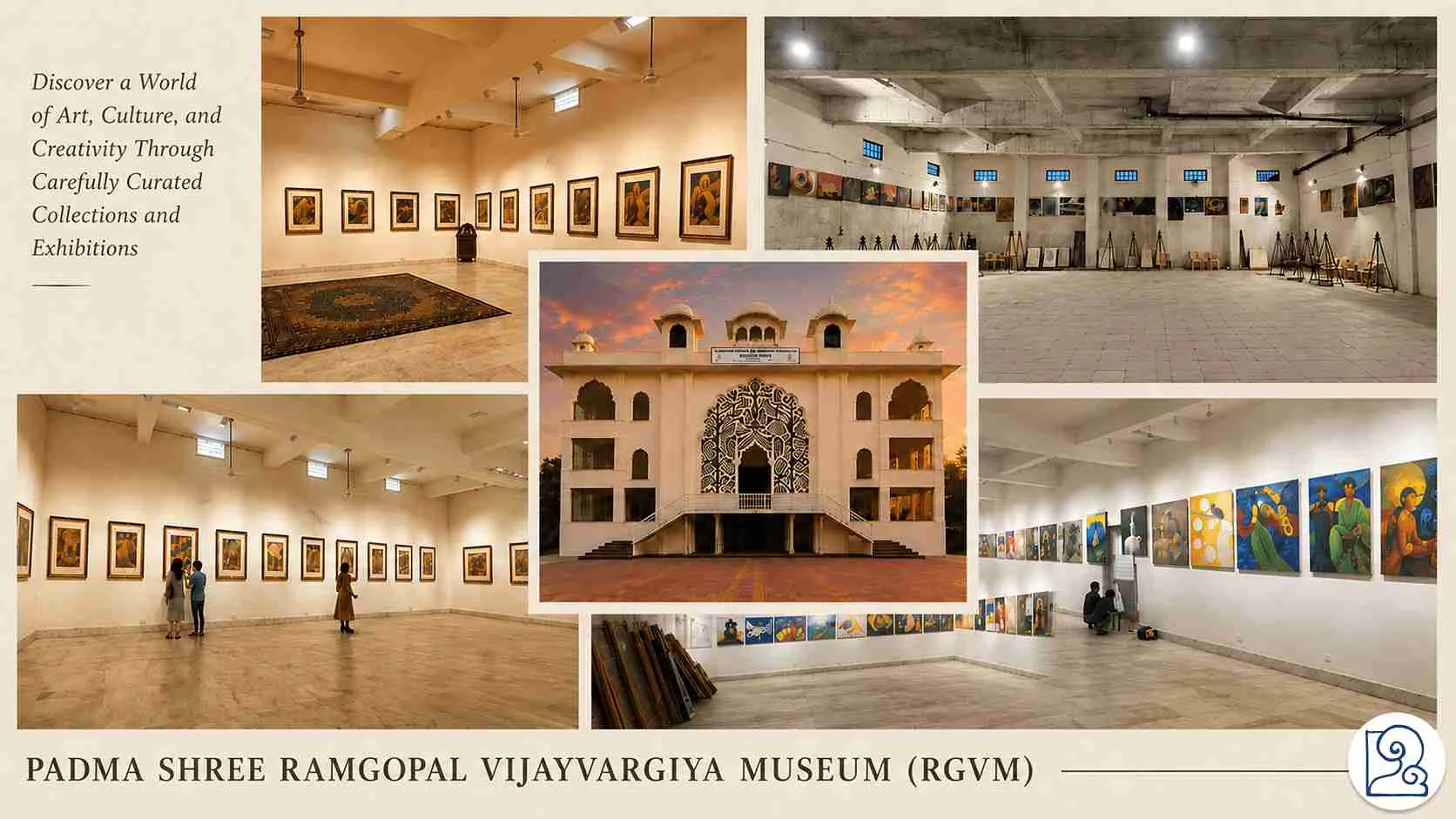
The building itself is part of the legacy. Designed as a direct dialogue with the art it houses, the museum is engineered with sand-tinted stone textures and delicate arches that pay homage to traditional Rajasthani courtyard architecture, set within an elegantly modern interior. Here, form follows reverence.
Every detail serves the work. The main pavilion is built with high ceilings and sophisticated indirect lighting that protect delicate watercolour wash pigments from direct sun. Natural overhead light is diffused through architectural screens, casting a subtle glow that draws out the translucent overlays and fine brush lines of the masterpieces — so the space reveals the art exactly as the artist intended it to be seen.
A Living Center of Art Education
A legacy kept only behind glass risks becoming a relic. RGV Museum was conceived as something more alive — an active cultural platform that nurtures the next generation of creative minds. Its inauguration, hosted by the Memorial Trust, drew distinguished art critics, scholars, and community leaders, signalling an institution intended to engage rather than merely archive.
That living role takes shape through ongoing programmes:
- Interactive workshops: wash-technique masterclasses led by esteemed veterans, teaching the historical watercolour overlay systems firsthand.
- Educational outreach: guided tours for schools and colleges that introduce young learners to regional art history.
- Artistic fellowships: support for researchers and young scholars studying post-independence modern art in Western India.
Through these continuous efforts, the delicate techniques and poetic sensibilities of Ram Gopal Vijayvargiya remain a living force in today's world, rather than a memory of the past.
A Legacy That Lives On
The legacy of RGV Museum is, finally, a living conversation — between a master and those who continue to learn from him, between heritage and modern vision, between the past and the eyes that meet it anew. It is a legacy measured not only in the 900 works it protects, but in every student who learns the wash technique, every scholar who deepens our understanding, and every visitor who pauses before a luminous landscape and feels something timeless.
Whether you come as an admirer of Indian art, a student of its history, or a collector drawn to original work of lasting significance, RGV Museum exists to keep that long conversation going — preserving the lyrical vision of Shri Ram Gopal Vijayvargiya, and carrying his heritage forward to new generations of attentive eyes.