
The Legacy of Jaipur's Blue Pottery: From Royal Workshops to Contemporary Art Collections
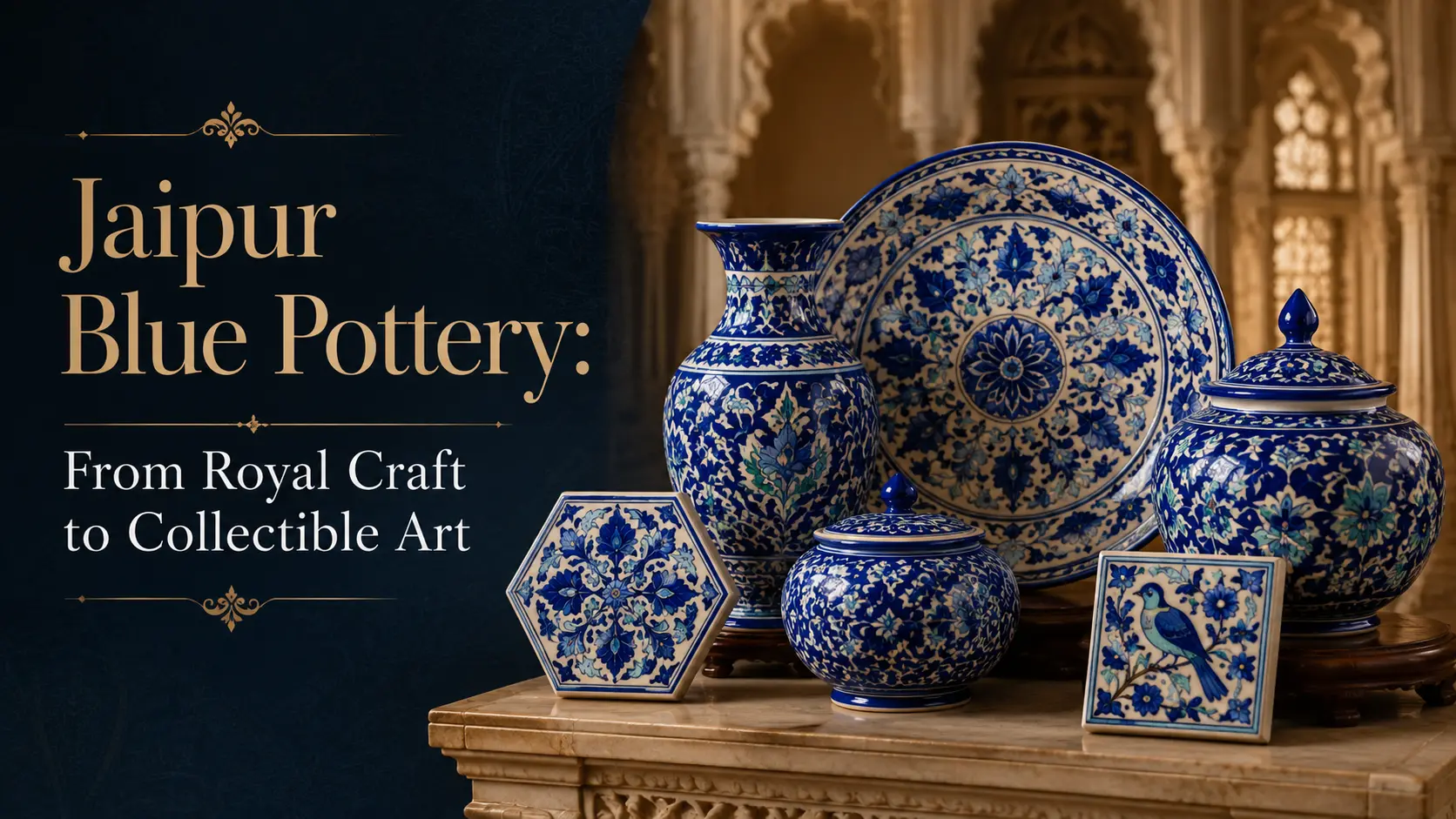
Few crafts capture the imagination quite like jaipur blue pottery, a glistening ceramic tradition whose cobalt glaze has come to symbolize the artistic soul of Rajasthan's Pink City. Distinct from almost every other ceramic form in India, this is pottery made without clay, decorated in serene shades of blue, green and white, and carrying within it a story of travel, royal patronage and refined artistry. To understand it is to trace a journey that begins in distant Central Asian workshops and arrives, centuries later, in the curated cabinets of contemporary collectors.
As one of the most beloved expressions of rajasthani art, blue pottery sits alongside Jaipur's celebrated miniature paintings and its sumptuous textiles such as bandhani, zari and zardozi. Yet it remains singular in technique and beauty. In this article we explore the craft's origins, its unusual making process, its rise from royal favour to a prized form of collectible art, and the reasons it continues to enchant interior designers, museums and private collectors today.
The Origins and Blue Pottery History of Jaipur
The roots of blue pottery history reach far beyond Rajasthan. The craft is Turko-Persian in derivation, an artistic lineage that travelled across Central Asia and the Islamic world before reaching the Indian subcontinent. Its decorative glazed wares were admired by the Mughals, and through this cultural exchange the technique gradually made its way into the courts of northern India.
It was in Jaipur, however, that the craft found a lasting home. Under the encouragement of the city's rulers, who were known patrons of the arts, skilled artisans were invited to develop and refine the technique within royal workshops. This patronage gave blue pottery the stability and prestige it needed to flourish, transforming an imported decorative style into a deeply local tradition.
Blue pottery is one of the rare crafts that arrived as a foreign influence and was so thoroughly embraced that it became an emblem of the city that adopted it.
Over time, the craft passed through cycles of prominence and quiet decline, sustained by families of artisans who preserved its secrets. Renewed interest in the twentieth century, supported by revivalists and cultural institutions, helped secure its place as one of the signature jaipur crafts recognized across India and beyond.
What Makes Blue Pottery Unique
The first thing that surprises many newcomers to indian ceramics is that Jaipur blue pottery contains no clay at all. This single fact sets it apart from nearly every other pottery tradition in the country and explains both its delicate beauty and its fragility.
A Body Without Clay
Instead of clay, the body of the pottery is built from finely ground quartz or glass. Artisans typically bind this material using a paste that may include Multani mitti (fuller's earth) and natural gum, creating a workable dough that can be shaped or pressed into moulds. Because the material behaves so differently from clay, it demands considerable skill to form and handle without cracking.
Low-Temperature Firing and the Signature Glaze
The shaped pieces are fired at a relatively low temperature, a characteristic that contributes to their distinctive lightness and their well-known fragility. The defining feature, of course, is the glaze. The classic palette centres on a rich cobalt blue, accented with copper-derived green and a clean white ground. This restrained yet luminous colour scheme is what gives the craft its name and its instantly recognizable character.
Motifs Drawn from Nature and Ornament
Decoration is where the artisan's hand becomes most visible. Common motifs reflect the craft's Persian heritage and its Indian setting alike. Collectors and admirers often look for:
- Floral patterns, from single blossoms to flowing vines and creepers.
- Birds, frequently rendered in graceful, stylized poses.
- Arabesque designs, with their interlacing geometric and vegetal forms.
- Borders and trellis work that frame and unify a piece.
Each item, from tiles and plates to vases, bowls and decorative jars, is hand-painted, meaning no two pieces are ever truly identical.
From Royal Workshops to Collectible Art
The evolution of blue pottery from a court-supported craft into a sought-after form of collectible art mirrors a broader shift in how handmade traditions are valued. What was once primarily decorative and functional is now appreciated as an expression of cultural heritage and individual artistry.
Several qualities make blue pottery especially appealing to collectors:
- Its handmade nature. Every piece is shaped and painted by hand, carrying small variations that signal authenticity and human craftsmanship.
- Its fragility. Because the quartz body is delicate and low-fired, well-preserved antique and vintage pieces are comparatively scarce, which adds to their desirability.
- Its artistry. The finest examples display confident brushwork, balanced composition and a depth of glaze that reflects genuine mastery.
- Its cultural narrative. Owning a piece means holding a small chapter of a long, cross-cultural story.
For those building a collection, provenance and condition matter a great deal. Pieces with documented origins, intact glaze and skillful painting tend to be the most treasured. As with much rajasthani art, knowledge deepens appreciation, and the more one understands the craft, the more rewarding collecting becomes.
Blue Pottery in Contemporary Art Collections and Interiors
Far from being confined to museum vitrines, blue pottery has found a vibrant place in modern life. Designers and homeowners are drawn to its calming palette and its ability to bridge the traditional and the contemporary.
A Versatile Decorative Language
The cool blues and greens of the glaze pair naturally with neutral interiors, warm woods and minimalist spaces, offering a point of artistic focus without overwhelming a room. A single statement vase, a cluster of decorative plates or a panel of hand-painted tiles can introduce both colour and cultural depth.
Bridging Heritage and Modern Taste
Contemporary artisans continue to experiment, applying traditional techniques to new forms and occasionally exploring fresh motifs while honouring the classic palette. This adaptability has helped keep the craft relevant, allowing it to sit comfortably in galleries, boutique hotels and private homes alike. As an enduring example of jaipur crafts, blue pottery demonstrates how living traditions can evolve without losing their essence.
For collectors of indian ceramics, the craft also offers an accessible entry point into a wider appreciation of Indian decorative arts, inviting deeper exploration of related traditions in metalwork, textiles and painting.
Caring for and Appreciating Blue Pottery
Because of its delicate construction, blue pottery rewards thoughtful handling. A few general principles help preserve its beauty:
- Handle pieces gently and support larger items from the base, as the low-fired body can chip or crack.
- Keep decorative pieces away from sudden temperature changes and harsh impacts.
- Clean with a soft, dry or lightly dampened cloth rather than abrasive materials.
- Display antique or fine pieces away from high-traffic areas where accidental knocks are likely.
Beyond preservation, true appreciation comes from looking closely: observing the steadiness of the brushwork, the harmony of the motifs and the subtle differences that mark each piece as the work of a particular hand.
Conclusion
The legacy of Jaipur's blue pottery is a testament to how artistic ideas travel, take root and transform. From its Turko-Persian origins to the royal workshops of Jaipur, and onward into the homes and collections of admirers around the world, this clay-less ceramic tradition continues to enchant with its luminous glaze and its quietly confident artistry. It remains one of the most distinctive achievements of rajasthani art and a proud emblem of the city that made it its own.
Whether you are beginning to explore collectible art or simply drawn to the serene beauty of these handmade pieces, blue pottery offers a meaningful way to connect with India's living heritage. At RGV Museum, we believe that appreciating and collecting Rajasthani and Indian art is, at heart, a way of keeping these remarkable traditions alive for the generations still to come.