
The Jaipur School of Miniature Paintings: Centuries of Artistic Excellence & Royal Patronage
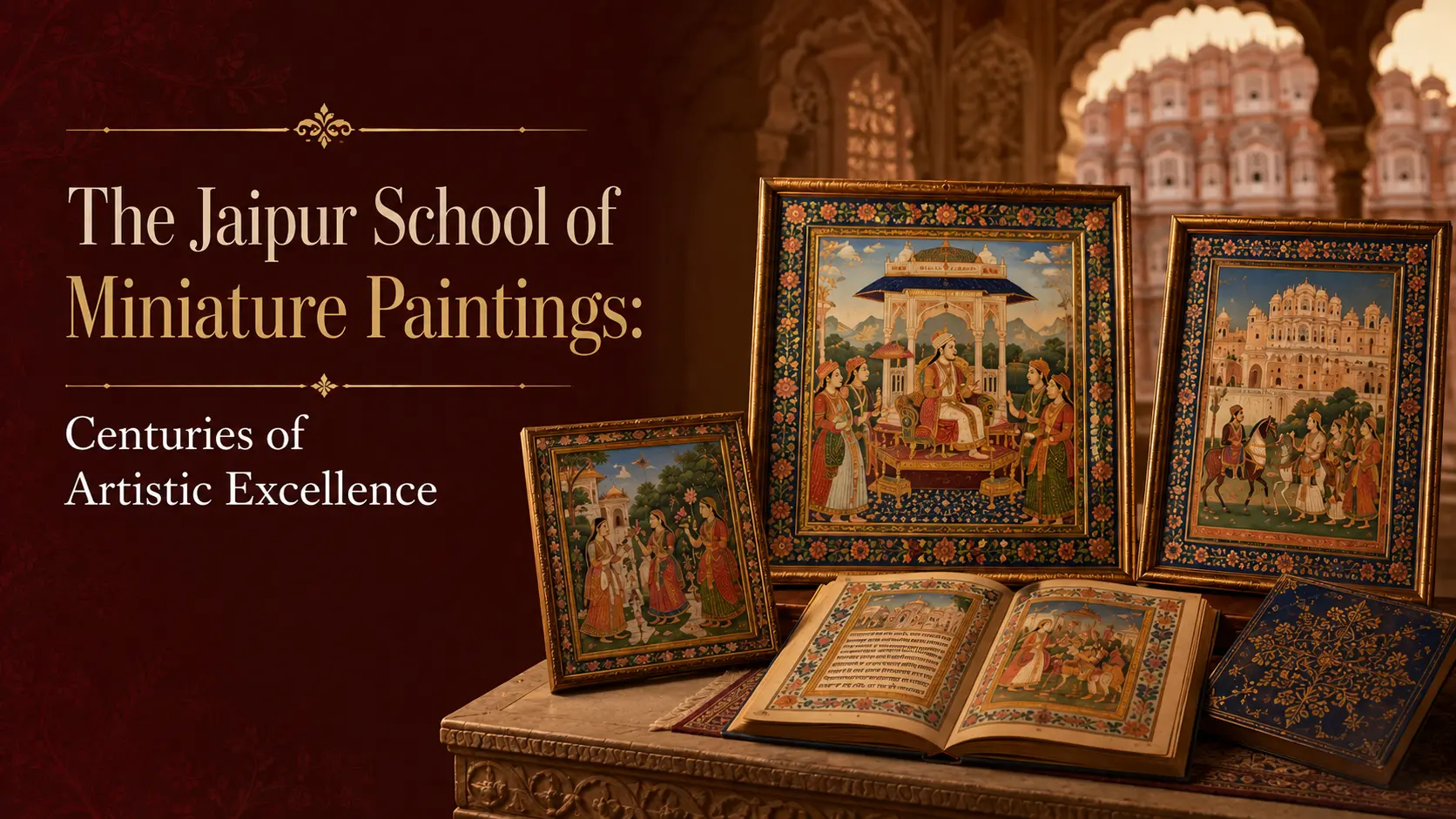
Few art forms capture the soul of a civilization as intimately as the jaipur miniature paintings born of Rajasthan's princely courts. Small enough to hold in the palm of a hand yet vast in their storytelling, these works distil entire worlds of devotion, romance, statecraft, and seasonal beauty into surfaces no larger than a folio page. The Jaipur school stands among the most refined chapters of the broader Rajput tradition, a lineage of indian miniature art shaped over centuries by the discerning taste of the Amber and later Jaipur court.
To look closely at a fine miniature is to witness patience made visible. A single garment may carry hundreds of brushstrokes; a border may shimmer with burnished gold applied leaf by leaf. For collectors and culture enthusiasts alike, understanding how these paintings came to be, what distinguishes the exceptional from the ordinary, and why they endure as both heritage and quiet investment opens a doorway into one of India's most enduring artistic legacies.
A Living Tradition: The History of the Jaipur School
The Jaipur school did not emerge in isolation. It belongs to the wider family of rajasthani miniatures that flowered across the desert kingdoms of western India, each court developing its own dialect of line, palette, and theme. Rooted in the artistic culture of Amber, the ancestral seat of the Kachhwaha rulers, the style matured further after the founding of Jaipur as a planned city in the eighteenth century.
Over time, the school absorbed influences from neighbouring traditions and from the sophisticated visual vocabulary of the Mughal ateliers, yet it retained a distinctly Rajput sensibility. The result was a manner of painting marked by clarity of composition, a love of ornamental detail, and a deep attachment to subjects drawn from courtly life and devotional poetry.
A miniature is not merely a picture to be glanced at. It is meant to be read slowly, the way one might savour a verse, discovering new detail with each return.
Stylistic Hallmarks: Detail, Pigment, and Gold
What makes the Jaipur and broader Rajasthani style so immediately recognisable is its devotion to craft. Artists worked at a scale that demanded extraordinary control, and the finest among them are said to have used brushes made from a single squirrel hair to render the most delicate passages, an eyelash, the curl of a vine, the glint in a courtier's eye.
The materials themselves were drawn from the earth and from the workshop's own knowledge of chemistry and craft. Pigments came from natural sources: minerals, stones, and plants ground into rich, lasting colour, often set against the warm gleam of gold leaf. These were not casual decisions; the choice and preparation of colour was an art unto itself.
Themes That Define the Tradition
The subject matter of these paintings reveals the world that commissioned them. Common themes include:
- Royal portraits and courtly life — rulers in durbar, processions, and scenes of leisure that doubled as records of status and power.
- Devotional subjects — episodes from the life of Krishna and Radha, beloved across Rajasthan and central to its spiritual imagination.
- Ragamala series — visual interpretations of musical modes, where melody, mood, and season are translated into image.
- Festivals and seasons — celebrations and the turning of the year, rendered with affection for ritual and atmosphere.
- Flora and fauna — gardens, birds, and animals observed with a naturalist's curiosity and a poet's tenderness.
Because of this range, each painting functions on two levels at once. It is a visual delight, and it is also a historical document, preserving the dress, architecture, customs, and beliefs of an era that left few other such intimate records.
Royal Patronage and the Karkhanas
None of this artistry would have been possible without sustained royal patronage. The courts of Amber and Jaipur were not merely admirers of painting; they were its lifeblood. Rulers maintained karkhanas, the royal ateliers or workshops where master artists, apprentices, and specialists laboured together under court support.
These workshops were remarkable institutions. Within a single karkhana, tasks were often divided so that one hand might draw the underlying composition, another apply colour, a third specialise in faces, and yet another in the burnishing of gold. Knowledge passed from master to pupil, and from one generation to the next, allowing styles to deepen and refine across decades.
Why Patronage Mattered
Patronage shaped not only the quantity of work produced but its character. A court that prized devotional poetry encouraged Krishna and Ragamala themes; a ruler proud of his lineage commissioned portraits and dynastic scenes. The artist's vision and the patron's taste met on the page, and the dialogue between them is part of what gives these works their richness.
Understanding this context helps a modern viewer appreciate that a miniature is rarely the product of a single isolated genius. It is, more often, the flowering of a workshop culture sustained by institutional support over a very long time, a tradition rather than a solitary act.
How to Appreciate Quality in a Miniature
For those new to the form, learning to look is the first pleasure. Quality in indian miniature art reveals itself in several ways, and a trained eye gradually learns to read them.
- Fineness of brushwork — Examine the smallest details. The crispness of a line, the steadiness of a contour, and the rendering of hair, jewellery, and textiles all betray the hand of a master or a lesser follower.
- Depth and harmony of pigment — Naturally derived colours tend to possess a particular warmth and luminosity. Note how the palette is balanced and whether the colour has aged gracefully.
- Use of gold — Burnished gold leaf, carefully applied and tooled, is a mark of ambition and skill.
- Composition — Strong works guide the eye through architecture, figures, and border with deliberate rhythm rather than crowding the surface at random.
- Coherence of theme — A successful painting unites subject, mood, and detail into a single felt experience.
Spending time with authenticated works in museums and reputable collections is the surest education. The eye learns by comparison, and there is no substitute for looking, again and again, at the genuine article.
Collecting and the Investment Value of Miniatures
Beyond their beauty, antique and contemporary miniatures hold real appeal as collectible paintings. Serious collectors are drawn to them not only for aesthetic pleasure but for their standing as enduring cultural assets. As with any field of art investment, however, knowledge protects the buyer, and a few considerations matter greatly.
What Serious Collectors Look For
- Provenance — A clear, documented history of ownership lends confidence and value. Knowing where a work has been, and through whose hands it has passed, matters enormously.
- Condition — Look carefully at the state of the paper or surface, the stability of the pigment, any flaking of gold, repairs, or losses. Condition strongly influences both enjoyment and long-term value.
- Pigment and materials — Naturally derived pigments and authentic gold work are hallmarks of traditional craftsmanship and help distinguish period works from later imitations.
- Quality of detail — As with appreciation, the finest brushwork commands the greatest regard among collectors.
- Authenticity — Where possible, seek expert opinion and reputable sources. The market rewards care and rewards patience.
Contemporary artists continue to work within this tradition, keeping the techniques and themes of the school alive. For collectors, these living works offer an accessible entry point as well as a way to support the continuation of a centuries-old craft, while the finest antique examples remain treasured for their historical depth.
A Closing Reflection
The Jaipur school of miniature painting endures because it speaks to something timeless: the human wish to make beauty carefully, and to preserve a world worth remembering. In its meticulous brushwork, its glowing pigments, and its quiet devotion to detail, it offers both delight to the eye and insight into a vanished way of life. The legacy of royal patronage lives on in every surviving folio.
Whether you come to these paintings as an admirer, a student of history, or a collector building something lasting, the reward is the same: a deeper intimacy with one of India's great artistic achievements. To appreciate or collect Rajasthani art is to keep that long conversation going, and institutions such as RGV Museum exist to help that heritage find new generations of attentive eyes.