
Rajasthani Folk Arts & the Ghoomar Dance: Preserving Living Cultural Heritage
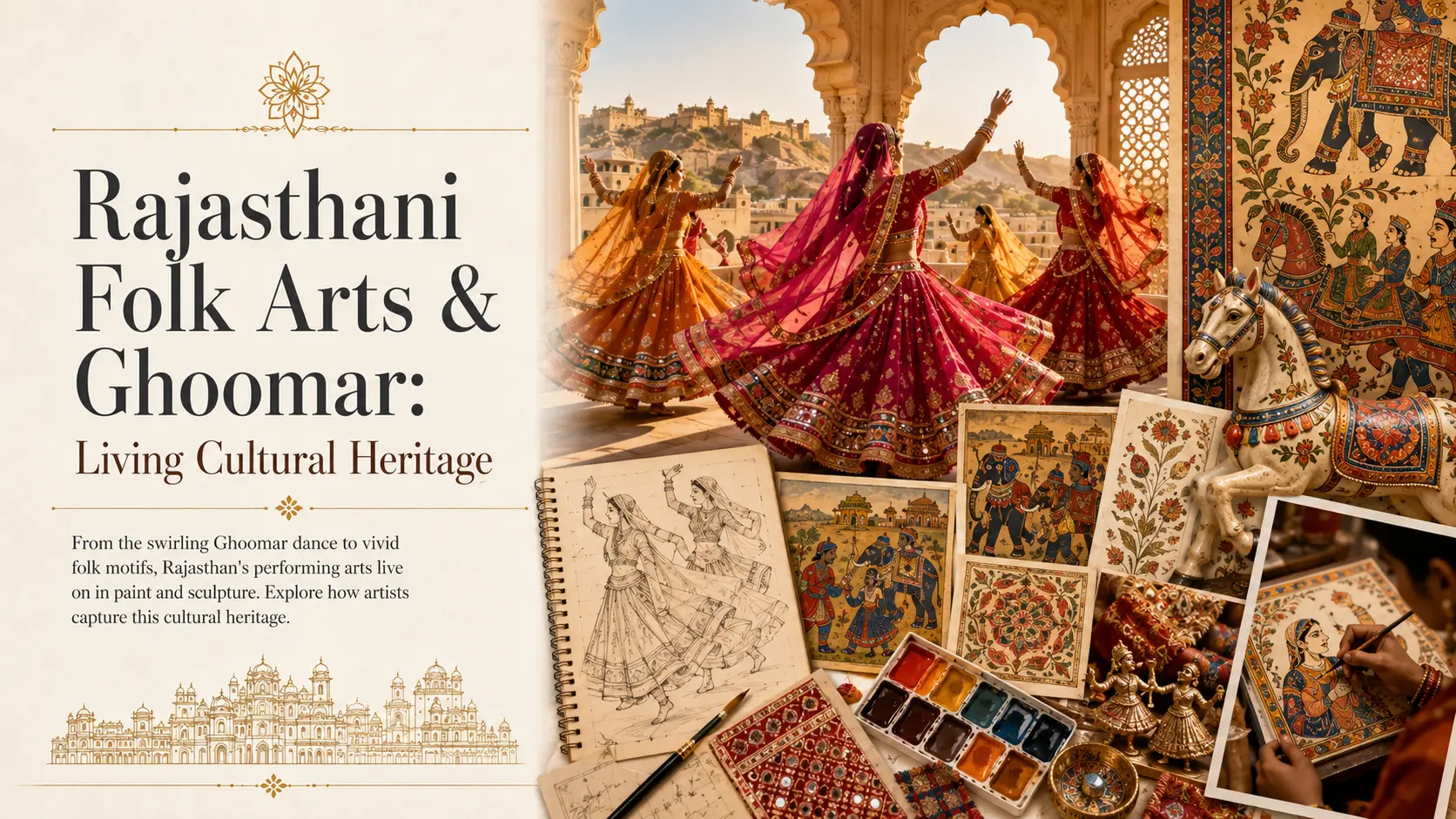
Few sights capture the spirit of rajasthani folk art as vividly as a circle of women in flowing ghagras, twirling in slow, hypnotic arcs while their veils lift like petals in the wind. This is the ghoomar dance, perhaps the most beloved emblem of rajasthan culture and a living thread that connects the desert's villages, courts, and festivals across generations. To watch it is to understand something essential about the region: that joy, devotion, and identity here are expressed through movement, colour, and rhythm as much as through stone and pigment.
Yet Ghoomar is only one bright star in a vast constellation of Rajasthani performing arts. From snake-charmer dances to ancient puppetry and the haunting ballads of hereditary musicians, the state holds some of India's richest folk traditions. These forms are not relics behind glass; they are living, breathing expressions of cultural heritage that continue to inspire visual artists, who translate their gestures, costumes, and spirit into paintings and sculpture. This article explores these traditions, their meaning, the challenge of preserving them, and the enduring conversation between performance and art.
The Ghoomar Dance: Grace in Motion
Ghoomar takes its name from ghoomna, the gentle pirouette that defines it. Traditionally performed by women, the dance is built around graceful, sweeping circles in which the long, layered ghagra fans outward, creating waves of colour that seem to bloom and dissolve with each turn. Dancers move in unison, their arms tracing elegant patterns while their faces remain serene beneath ornate veils. The effect is meditative and celebratory at once.
The dance is woven into the fabric of community life. It marks weddings, festivals, and joyous welcomes, and was historically associated with both the Bhil community and Rajput courtly tradition, where it became a graceful rite for women on auspicious occasions. In some regional forms, dancers raise the difficulty considerably, balancing lit lamps or earthen pots, sometimes crowned with a flickering diya, upon their heads as they spin, transforming the performance into a quiet feat of poise and devotion.
To dance Ghoomar is to carry the memory of a place in one's body, turning history into something felt rather than simply remembered.
Why Ghoomar Endures
Part of Ghoomar's lasting appeal lies in its accessibility and warmth. It welcomes participation across ages, it celebrates the feminine, and its visual splendour, the swirl of mirrored skirts and bright textiles, makes it instantly recognisable far beyond Rajasthan's borders. As a symbol, it has come to stand for the dignity and exuberance of rajasthani folk art as a whole.
Beyond Ghoomar: A Spectrum of Folk Traditions
While Ghoomar may be the most famous, Rajasthan's folk traditions are remarkably diverse, each tied to particular communities, landscapes, and ways of life. Together they form a layered cultural ecosystem that has evolved over centuries.
- Kalbeliya dance: Performed by the Kalbeliya community, historically linked with snake charmers, this dance is known for its sinuous, serpentine movements and swirling black costumes. It is widely recognised as an important expression of intangible cultural heritage.
- Bhavai: A breathtaking balancing act in which performers dance while stacking and steadying multiple pots on their heads, often atop the edge of a sword or a glass, blending acrobatic skill with grace.
- Kathputli puppetry: Rajasthan's celebrated string-puppet tradition, in which carved and brightly painted wooden figures act out folk legends, heroic tales, and moral stories to live narration and music.
- Folk music traditions: The hereditary musician communities, notably the Manganiyar and Langa, who sustain a deep repertoire of ballads, devotional songs, and desert melodies passed down through families.
Music as the Heartbeat
The Manganiyar and Langa musicians deserve special note. As hereditary performers, they have preserved oral repertoires across generations, accompanying births, weddings, and seasons with voice and instruments such as the kamaicha and dholak. Their music is the soundtrack to many of Rajasthan's dances, binding the various performing arts into a shared cultural language.
The Cultural Significance of Living Heritage
What distinguishes these art forms is that they are living. Unlike a monument or a manuscript, a folk dance or song exists only in the moment of performance and in the memory of those who carry it forward. This makes them powerful, intimate, and also fragile. Each form encodes a wealth of meaning, social roles, seasonal rhythms, religious devotion, communal identity, and historical memory.
Across rajasthan culture, these traditions function as more than entertainment. They mark transitions in life, reinforce bonds within communities, and offer a sense of continuity in a rapidly changing world. The vivid costumes, repeated motifs, and stylised gestures are themselves a kind of visual vocabulary, one that has long fascinated painters and sculptors.
The Challenge of Preserving Living Heritage
Preserving a living tradition is far more delicate than conserving an object. A painting can be stored, restored, and displayed; a dance must be taught, practised, and performed to survive. As younger generations migrate to cities and livelihoods shift, the transmission of these skills faces real pressure.
Several broad challenges recur across Rajasthan's folk traditions:
- Generational transmission: Many forms rely on knowledge passed within families and communities, which can weaken as economic and social patterns change.
- Sustainable livelihoods: Performers and artisans need viable ways to earn from their craft so that tradition remains a living profession rather than a fading memory.
- Authenticity amid adaptation: As folk forms reach wider audiences and stages, there is a constant, careful balance between evolving for new contexts and honouring their roots.
- Documentation and recognition: Recording repertoires, costumes, and techniques helps safeguard them, while public appreciation gives communities a reason to continue.
Encouragingly, festivals, cultural institutions, and growing interest from collectors and travellers all play a part in keeping these traditions vibrant. When audiences value the artistry, the artists are empowered to pass it on.
From Performance to Painting: How Artists Capture the Spirit
Perhaps the most fascinating dimension of Rajasthan's performing arts is how they ripple outward into visual art. For centuries, painters have been drawn to the colour, motion, and emotion of folk performance, finding in it an inexhaustible source of subject and feeling.
Translating Movement into Stillness
Capturing a dance on canvas is its own quiet art. A painter must distil the swirl of a ghagra, the tilt of a veiled head, or the balanced poise of a Bhavai performer into a single, eloquent moment. Artists achieve this in several ways:
- Gesture and posture: Conveying the implied motion of a spin or a raised arm so the figure feels alive even in stillness.
- Colour and textile: Echoing the brilliant reds, ochres, and mirror-work of folk costume, which translate naturally into rich, saturated palettes.
- Motif and ornament: Borrowing the decorative vocabulary of folk traditions, from jewellery to embroidery patterns, as visual rhythm within the composition.
- Atmosphere: Suggesting the festive light of lamps, the dust of the desert, or the communal energy that surrounds a performance.
In this way, a fleeting ghoomar dance becomes something a collector can live with, contemplate, and pass on, a bridge between the ephemeral and the enduring. The painter becomes, in a sense, another kind of preserver of cultural heritage, ensuring that the spirit of the performance outlasts the performance itself.
Conclusion: Keeping the Circle Turning
Rajasthan's folk arts, from the radiant turns of Ghoomar to the sinuous Kalbeliya, the balancing feats of Bhavai, the storytelling of Kathputli, and the timeless songs of the Manganiyar and Langa, form one of India's most luminous cultural inheritances. They remind us that heritage is not only something we look at, but something we live, perform, and share. Their survival depends on appreciation as much as on practice.
To collect or simply admire a painting inspired by these traditions is to participate, gently, in their continuation, to keep the circle turning. Whether through a quiet afternoon spent appreciating Rajasthani art at the RGV Museum or through the joy of bringing a meaningful work into your own home, every act of attention helps these living traditions endure for generations to come.