
Jantar Mantar: Where Scientific Precision Meets Artistic Brilliance
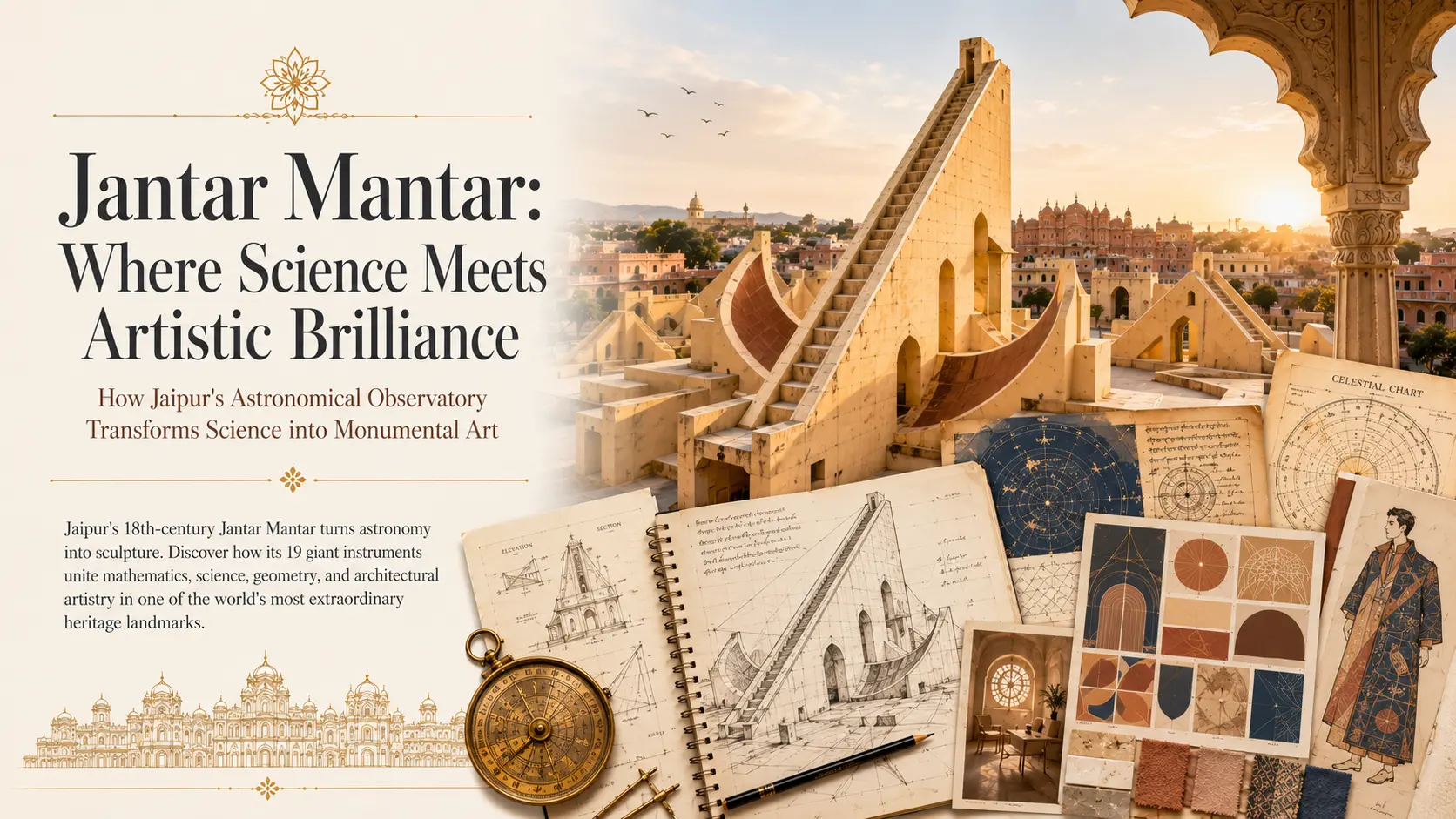
Stand at the heart of Jaipur's old city, beneath the wide Rajasthani sky, and you will find a place where the boundaries between a laboratory and a sculpture garden quietly dissolve. Jantar Mantar, the great stone jaipur observatory built in the early eighteenth century, is at once a working scientific instrument and a breathtaking work of monumental art. Its sweeping ramps, curved arcs and towering geometric forms were engineered to read the heavens — to measure time, follow the sun and stars, and anticipate eclipses — yet they arrest the eye like abstract modern sculpture conceived three centuries ahead of its time.
For lovers of astronomy art and admirers of Rajasthan's heritage, the observatory offers something rare: proof that science and art are not opposing pursuits but kindred ones, born from the same human impulse to observe the world carefully and render it in proportion. Here, the precision of mathematics becomes visible, tangible, and unmistakably beautiful.
A Vision in Stone: The Origins of Jantar Mantar
The Jaipur Jantar Mantar was conceived by Maharaja Sawai Jai Singh II, the scholarly ruler who founded the city itself. Completed around 1734, it is the largest and best preserved of several such observatories he commissioned across northern India. Jai Singh was a passionate student of astronomy who gathered manuscripts and ideas from Indian, Islamic and European traditions, then translated that accumulated knowledge into masonry and stone.
Rather than relying solely on small brass instruments, which were prone to error at human scale, he reasoned that larger instruments would yield more accurate readings. The result was a complex of nineteen monumental architectural instruments, or yantras, each designed for a specific astronomical task. The decision to build big was a scientific one — but it gave the world an unintended gift of grand, abstract form.
The observatory reflects a moment when a ruler believed that understanding the cosmos was worth shaping the earth itself.
The Instruments: Where Architectural Art Meets the Cosmos
To walk among the yantras is to move through a landscape of pure geometry. Each instrument is a study in line, curve and shadow, and together they form a remarkable expression of architectural art. What makes them so compelling to artists and designers is that their beauty is entirely functional — not a single curve is decorative for its own sake, yet the whole reads as deliberate composition.
The Samrat Yantra: The Supreme Instrument
The centrepiece is the Samrat Yantra, an enormous equinoctial sundial and one of the largest sundials in the world. Its great triangular gnomon rises dramatically against the sky, casting a shadow that sweeps across curved marble scales below. The instrument was built to tell local time with extraordinary precision, tracking the sun's movement throughout the day. Seen purely as a form, it is monumental minimalism — a single bold diagonal answered by gentle arcs.
A Family of Yantras
Beyond the Samrat Yantra, the observatory hosts an array of instruments, each with a distinct purpose and silhouette. Among the most admired are:
- The Jai Prakash Yantra — concave hemispherical bowls marked with reference lines, used to locate celestial bodies and read coordinates in the sky.
- The Ram Yantra — paired cylindrical structures with open centres, designed to measure the altitude and azimuth of the sun and stars.
- The Rashivalaya Yantras — a set of instruments corresponding to the signs of the zodiac, used for tracking celestial positions along the ecliptic.
- The Nadivalaya Yantra — a pair of circular dials oriented to measure time and the sun's path across the seasons.
Each was crafted to read time, follow the heavens, and help predict events such as eclipses. Standing among them, a visitor experiences the strange sensation of walking inside a scientific diagram rendered at architectural scale.
A UNESCO Treasure in the Pink City
The cultural significance of the site is formally recognised: Jaipur's Jantar Mantar is a UNESCO World Heritage Site, celebrated as one of the most significant and comprehensive observatories of its kind from the pre-telescope era. The designation honours not only its scientific ingenuity but also its expressive embodiment of cosmology, sovereignty and learning during a vibrant period of Indian history.
The honour of unesco jaipur recognition places the observatory in dialogue with the city's wider heritage — its planned streets, its palaces, and its long tradition of patronising both the sciences and the arts. To understand Jantar Mantar is to understand something essential about Jaipur itself: a city designed with intention, where order and beauty were never seen as separate goals.
The Same Roots: Observation, Proportion and Beauty
Why does a working observatory move us the way a great sculpture does? The answer lies in what science and art share. Both begin in observation — the patient watching of how light falls, how shadows lengthen, how forms relate to one another in space. Both depend on proportion — the careful ratios that make a calculation accurate and a composition pleasing. At Jantar Mantar, these shared roots are laid bare in stone.
The genius of the place is that its aesthetic power is a direct consequence of its accuracy. The gnomon is angled precisely to the latitude of Jaipur; the curved scales follow the geometry of the heavens. Nothing is arbitrary, and that is precisely why the eye trusts it. This is the heart of astronomy art: beauty arrived at not through ornament, but through truth to natural law.
Inspiring the Modern Eye: Minimalism and Geometric Design
It is little wonder that contemporary creators continue to draw inspiration from the observatory. Photographers, architects, painters and designers are repeatedly captivated by its clean diagonals, its interplay of light and shadow, and its confident use of negative space. The yantras anticipate, by centuries, the language of modern minimalist and geometric aesthetics.
For artists working today, Jantar Mantar offers a deep well of motifs and ideas:
- Pure geometric form — arcs, triangles, hemispheres and cylinders that translate naturally into abstract and minimalist composition.
- Light as a medium — the constant dance of shadow across the instruments invites studies in time, change and impermanence.
- Scale and presence — the monumental quality of the structures speaks to ideas of human ambition and our relationship to the cosmos.
- The marriage of discipline and wonder — a reminder that rigorous structure and emotional resonance can coexist in a single work.
In this sense, the observatory is not a relic frozen in the eighteenth century. It remains a living source of science and art, continually reinterpreted by new generations who see in its forms a vocabulary that feels strikingly contemporary.
Conclusion: A Monument to Curiosity
Jantar Mantar endures as one of the most eloquent statements ever made about the unity of knowing and seeing. Built to chart the sky with the tools of mathematics, it ended up creating an enduring masterpiece of architectural art — a place where a sundial becomes a sculpture and a calculation becomes a composition. It reminds us that the same careful attention that produces an accurate measurement can also produce profound beauty.
To appreciate the observatory is, in a small way, to appreciate the wider spirit of Rajasthani creativity — a culture that has long woven precision, devotion and artistry into everything from architecture to painting. If your visit to the jaipur observatory leaves you eager to carry a piece of that spirit home, exploring the rich tradition of Indian and Rajasthani art, such as the works collected and celebrated at RGV Museum, can be a quietly rewarding next step on that journey.