Jaipur's Festivals as Artistic Canvas: Teej, Elephant Festival & Kite Festival Through Art
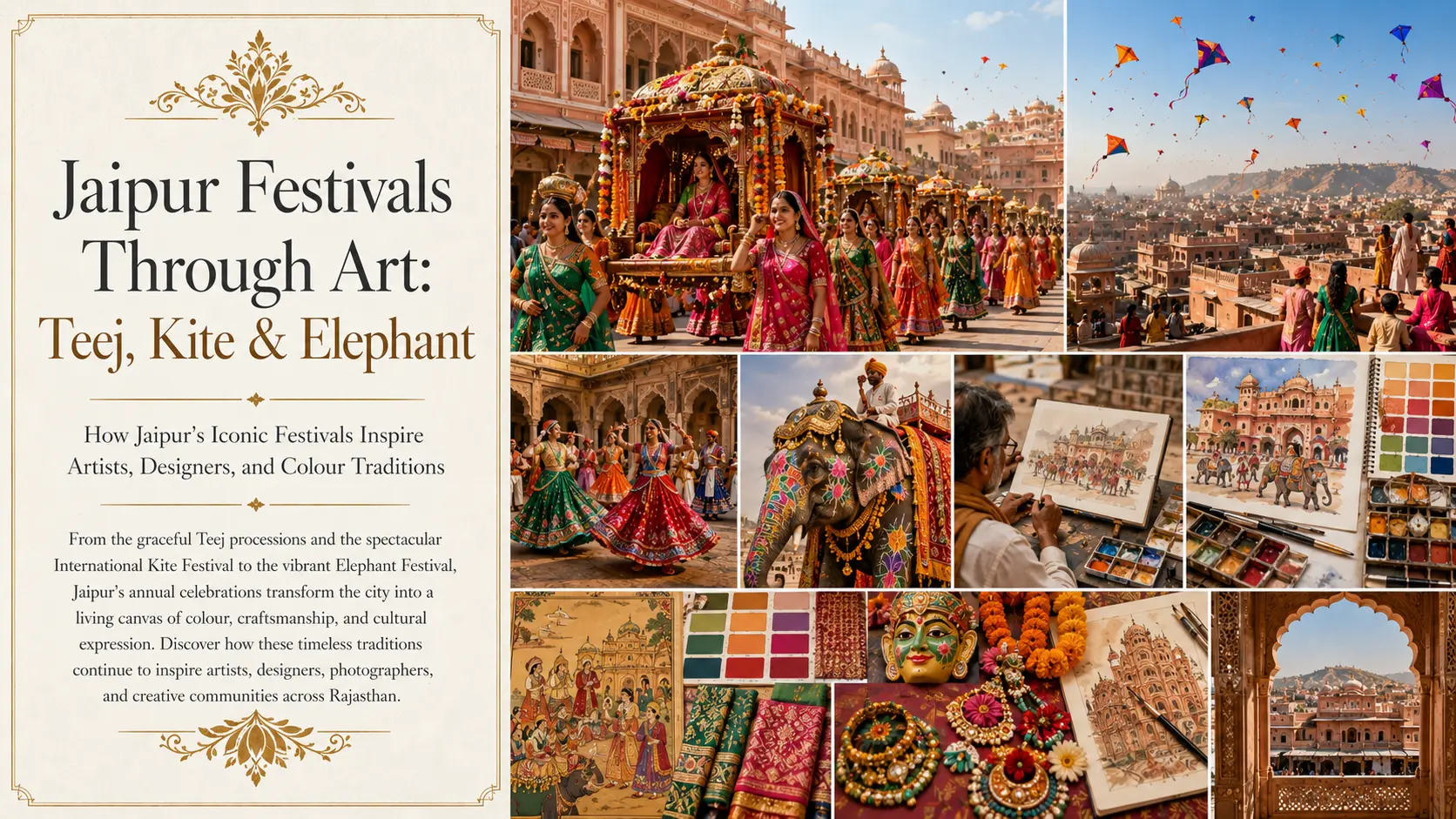
Few cities wear celebration as gracefully as Jaipur. The Pink City does not merely observe its festivals; it dresses for them, paints itself in their honour, and lets their rhythms spill into its streets, courtyards and skies. From the soaring kites of Makar Sankranti to the gilded elephants that herald the arrival of Holi, and the swinging, green-clad processions of Teej, the calendar of jaipur festivals reads like a sequence of living paintings. Each one offers a palette, a mood and a cast of characters that have long drawn the eye of artists.
This intimate relationship between celebration and creativity is no accident. For centuries, the courts and bazaars of Rajasthan nurtured painters who recorded the seasons, the deities and the pageantry of public life. The festival, with its concentrated colour and emotion, became a natural subject. To understand Rajasthani art is, in part, to understand how the region turned its festivals into an artistic canvas.
Why Jaipur's Festivals Became an Artistic Canvas
Festivals compress a year's worth of visual intensity into a few luminous days. Streets that are ordinarily ochre and dusty are suddenly draped in marigold, vermilion and emerald. Crowds move in choreographed waves; light shifts from the cool blue of dawn processions to the gold of late afternoon. For a painter, this is an extraordinary gift: ready-made composition, heightened colour and unguarded human feeling all in one place.
The tradition of festival art in Rajasthan grew from this abundance. Court ateliers and folk workshops alike treated celebrations as worthy subjects, capturing not only the events themselves but the spirit behind them. The result is a visual culture in which devotion, seasonality and joy are inseparable from line and pigment.
Colour as a Cultural Language
In Rajasthani visual tradition, colour is rarely decorative alone; it carries meaning. Green signals the monsoon and renewal, saffron speaks of devotion and energy, and deep reds evoke festivity and auspiciousness. Artists drawing on festival imagery inherit this vocabulary, so that a single hue can summon an entire season or sentiment. The bold, high-contrast palettes seen in much Rajasthani painting owe a great deal to the chromatic drama of the city's celebrations.
Makar Sankranti and the Kite Festival: A Sky Full of Colour
Among the most visually striking of all jaipur festivals is the International Kite Festival, held on Makar Sankranti in mid-January. As the day marks the sun's transition and the lengthening of daylight, the people of Jaipur take to their rooftops and the sky fills with countless kites in every conceivable colour. The horizon becomes a moving abstraction of diamonds and tails, threaded with shouts of friendly competition.
For artists, the kite festival is almost a found composition. Few subjects offer such a natural interplay of geometry, movement and open space. The scene lends itself to studies of pattern and rhythm, where small bursts of pigment scatter across a vast pale field of sky.
What Draws Painters to the Kite Festival
- Geometry in motion — the angular shapes of kites set against the curve of the sky create dynamic, almost modernist compositions.
- Layered depth — kites near and far establish perspective, a quality painters love to explore.
- Colour against emptiness — bright forms float in negative space, a balance prized in both miniature and contemporary work.
- Community and rooftop life — the festival captures Jaipur's people in candid, joyful gathering, ideal for figurative studies.
Whether rendered in the fine detail of traditional technique or the loose gestures of modern brushwork, the kite-filled sky of Makar Sankranti remains one of the city's most painterly sights.
The Elephant Festival: Pageantry as Living Decoration
Held traditionally around the eve of Holi, Jaipur's Elephant Festival is perhaps the most ornamental of the city's celebrations. Elephants are adorned with painted patterns, embroidered textiles and intricate ornaments, transforming the animals themselves into walking works of art. The procession that follows is a spectacle of colour, ceremony and craftsmanship.
This festival blurs the line between celebration and artistry more openly than any other. The decoration of the elephants is itself a discipline, drawing on motifs found across Rajasthani design: floral borders, paisleys, geometric repeats and bold field colours. In a very real sense, the festival is a canvas before any painter arrives.
The Elephant Festival reminds us that in Rajasthan, decoration is never merely surface. It is a language of honour, joy and identity, applied with the same care a painter brings to a panel.
From Procession to Painting
The grandeur of the elephant procession has made it a recurring subject in Rajasthani art, where ceremonial animals, royal retinues and festive crowds were long-standing themes. Contemporary artists continue to find inspiration here, drawn to the contrast between the great, patient forms of the elephants and the riot of detail layered upon them. The festival offers scale and intimacy at once: a monumental subject covered in delicate ornament.
Teej: The Monsoon, the Goddess and the Colour Green
If the kite festival belongs to winter's clear skies, Teej belongs to the monsoon. Celebrating the season of rain and honouring the goddess Parvati, Teej fills Jaipur with processions, decorated swings, folk songs and dances. Women dress in green, the colour of fertility and renewal, and the city takes on a softer, more lyrical mood than the high energy of its other festivals.
Teej has long been a favourite subject in Rajasthani painting, where the image of a woman on a swing beneath a clouded, rain-laden sky became almost emblematic of the monsoon itself. The festival's themes of longing, devotion and seasonal joy give artists an emotional register quite distinct from the celebratory bustle of other occasions.
Motifs and Moods of Teej in Art
- The swing — a recurring visual motif suggesting movement, leisure and the gentle rhythm of the season.
- Greens and monsoon greys — a palette that signals renewal and the relief of rain after summer heat.
- Folk performance — singing and dancing figures bring narrative and grace to festival compositions.
- Devotional undertone — the presence of the goddess lends many works a quiet spiritual depth.
In Teej, festival and feeling merge. The celebration is not only seen but felt, and that emotional quality is precisely what gives its depictions their lasting appeal.
Festival Art and the Living Visual Culture of Jaipur
Taken together, these celebrations have shaped more than individual paintings; they have influenced the very visual culture of the region. The preference for saturated colour, the comfort with ornament, the love of pattern and procession — all of these traits in Rajasthani and modern Indian art draw nourishment from the festive calendar.
Contemporary artists continue this dialogue. Some return to traditional festival subjects with fresh techniques, while others abstract the experience into colour and form, letting the memory of a kite-filled sky or a swing in the rain guide their palette rather than their subject. In both approaches, the festival remains a source: a reservoir of imagery, emotion and cultural meaning that artists draw upon again and again.
Why This Matters for Collectors
For those who appreciate or collect Indian art, understanding the festival roots of an image deepens its resonance. A monsoon green, a decorated elephant, a scatter of kites — these are not random choices but echoes of a living tradition. Recognising them allows a collector to read a work more fully, connecting brushstroke to season, and pigment to celebration.
Conclusion: Celebration as the Source of Creativity
Jaipur's festivals are far more than dates on a calendar. They are the city's recurring acts of self-portraiture, each one offering colour, motif and mood to the artists who watch and remember. From the geometry of the kite festival and the radiant pageantry of the Elephant Festival to the lyrical green of Teej, these celebrations turn the everyday city into an artistic canvas, and in doing so keep its creative traditions alive.
To appreciate festival art is to appreciate the link between joy and making, between a community at celebration and an artist at work. If these traditions move you, you may find that exploring Rajasthani and modern Indian painting — including the works gathered at RGV Museum — offers a quiet, lasting way to carry a little of Jaipur's festive light home.