Jaipur's Cafe Culture as Modern Art Spaces: Where Heritage Meets Creative Expression
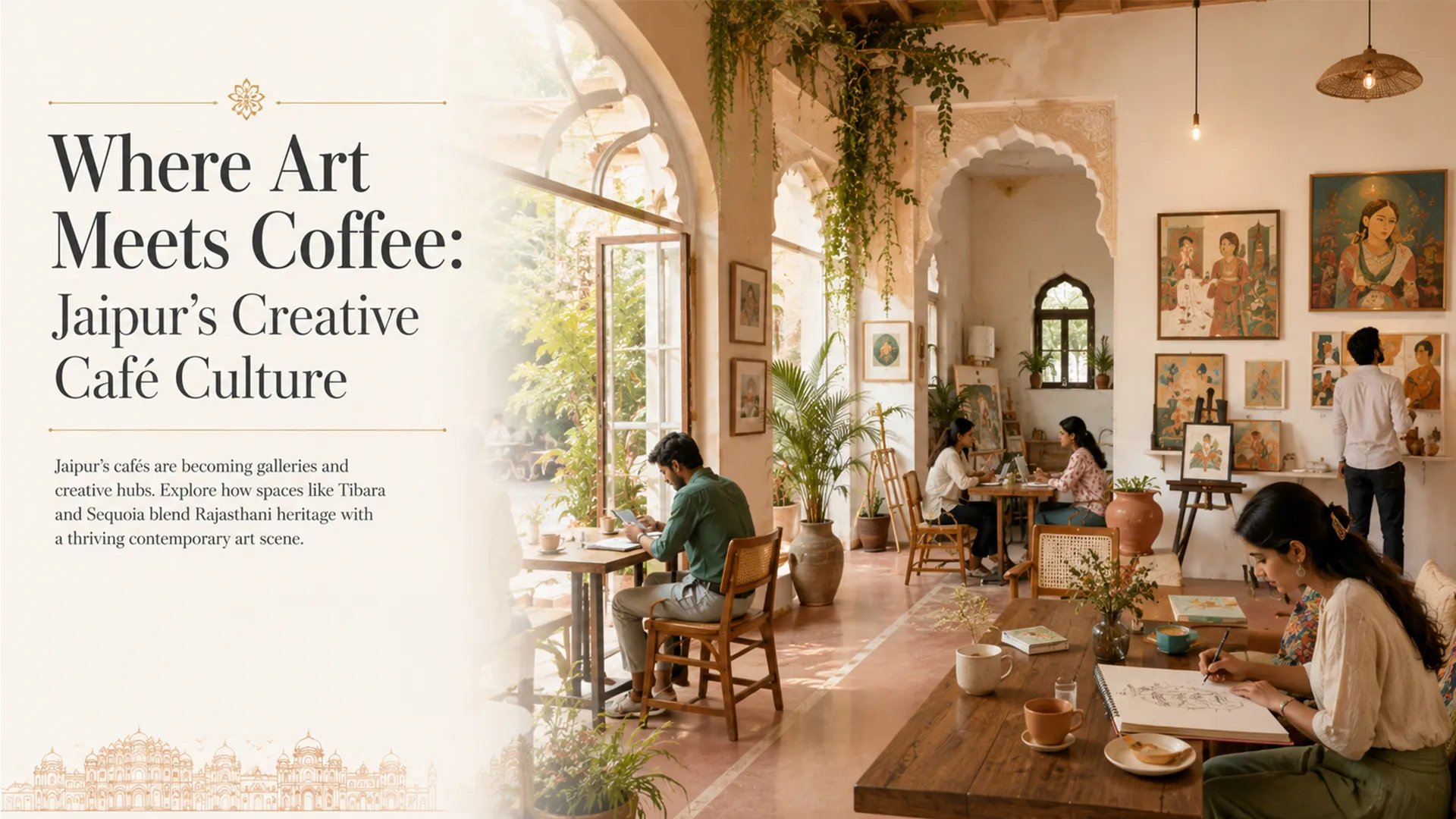
Walk through the lanes of Jaipur today and you will notice something quietly remarkable taking shape behind carved wooden doors and sandstone facades. The Pink City, long celebrated for its forts, frescoes and centuries-old craft traditions, is now home to a flourishing constellation of jaipur art cafes — spaces where a cup of masala chai shares a table with sketchbooks, where lime-washed heritage walls double as rotating galleries, and where a freelancer's laptop hums beside an artist's open canvas. This is more than a trend in interior decor. It is the emergence of a creative ecosystem that blends Rajasthan's storied past with a confident, contemporary present.
Across the city, a growing community of artists, writers, musicians, designers and culture lovers is finding a natural home in these hybrid venues. Art-forward cafes have become informal cultural hubs, drawing in remote workers, art students, travellers and photography enthusiasts who come as much for the atmosphere and conversation as for the coffee. In doing so, they are reshaping how Jaipur thinks about creative space — and quietly contributing to a contemporary art scene that feels distinctly its own.
The Rise of Jaipur Art Cafes as Creative Spaces
For generations, the cafe has been a gathering place for ideas. From the literary salons of Europe to the adda culture of Indian cities, food and drink have long served as the social glue that brings creative minds together. Jaipur's version of this story is rooted in something particular: a deep reservoir of craft heritage and a new generation eager to reinterpret it.
The creative spaces jaipur now offers tend to share a common philosophy. Rather than treating art as decoration applied after the fact, they build the creative experience into the very purpose of the venue. A cafe might host a changing wall of paintings by local artists, set aside an evening for poetry, or invite a ceramicist to lead a weekend workshop. The result is a place that feels alive and participatory rather than merely transactional.
What draws people to these spaces is a combination of qualities that traditional galleries and conventional coffee shops rarely offer together:
- Accessibility — art encountered casually, without the formality or intimidation of a white-cube gallery.
- Atmosphere — interiors that celebrate Rajasthani architecture, light and craft, making the setting itself a subject for photographers.
- Community — a steady rhythm of regulars, newcomers and visiting creatives who turn strangers into collaborators.
- Flexibility — comfortable corners for remote work by day that transform into venues for events by night.
Where Heritage Meets Contemporary Design
Part of what makes Jaipur's cafe culture so compelling is the way it converses with the city's architectural and artisanal legacy. Many of these venues occupy or echo heritage structures — havelis, restored courtyards and buildings that carry the texture of the old city. Within these settings, contemporary art, design and furniture are introduced thoughtfully, creating a dialogue rather than a clash.
Spaces Like Tibara and Sequoia Cafe
Venues such as Tibara illustrate how heritage architecture can be reimagined as a backdrop for modern hospitality and design, with restored detailing and a sense of grandeur that honours its surroundings. Spaces like Sequoia Cafe, meanwhile, point to the more intimate, design-led end of the spectrum, where a considered aesthetic and a relaxed creative mood invite visitors to linger. Both are best understood as illustrations of a broader movement rather than as isolated examples — the city has many such spaces, each interpreting the meeting of old and new in its own way.
The genius of these venues lies in restraint. Rather than overwhelming a heritage interior with modern intervention, the most successful spaces let the original craftsmanship breathe. Hand-carved jharokhas, traditional block-printed textiles and locally sourced stone sit comfortably alongside contemporary canvases and clean-lined furniture. For a visitor with a camera, every corner becomes a study in contrast and continuity.
Why the Aesthetic Matters
This visual richness is not merely decorative. It quietly educates. A traveller who came for coffee may leave with a deeper curiosity about Rajasthani miniature painting, frescoes or the region's textile traditions. The cafe becomes an informal classroom, where heritage is experienced rather than catalogued — and that experiential quality is precisely what makes it resonate with younger audiences.
How Cafe Culture Supports Emerging Artists
Perhaps the most meaningful contribution of these venues is the practical support they extend to artists who are still building their careers. Traditional gallery representation can be difficult to secure, and exhibition costs are often prohibitive for someone early in their journey. Art-forward cafes lower these barriers in several tangible ways.
- Wall space — offering emerging painters and illustrators a visible, low-pressure platform to show and sell their work to a steady stream of visitors.
- Pop-up events — hosting short exhibitions, craft markets and design showcases that connect makers directly with buyers.
- Open mics and performances — giving poets, musicians and storytellers a stage to test new material before a warm, receptive audience.
- Workshops and classes — inviting practitioners to teach skills, from sketching to pottery, generating income while nurturing the next wave of creators.
These opportunities do more than fill a wall or a calendar. They create the kind of feedback and encouragement that early-career artists need most. As one way of thinking about it goes:
A community is not built in studios alone; it is built in the spaces where artists meet their audience, and where the audience becomes part of the work.
This is where the value of a genuine art community becomes clear. The conversations sparked over a shared table — between a painter and a writer, a photographer and a designer, a student and a seasoned practitioner — often lead to collaborations, commissions and friendships that ripple outward into the wider cultural landscape.
Fuelling Jaipur's Contemporary Art Scene and Creative Economy
Taken together, these venues are doing something larger than serving good food in beautiful rooms. They are helping to build infrastructure for the city's contemporary art scene — the connective tissue that links artists, audiences and patrons. In a creative economy, such infrastructure is invaluable, because talent alone rarely flourishes without places to gather, show and be seen.
A Self-Sustaining Creative Loop
The dynamic at work is encouragingly circular. Cafes attract creative people, who in turn enrich the cafes with energy, work and events. That activity draws visitors and collectors, whose interest and spending support both the venues and the artists. The artists, sustained by this momentum, produce more work and host more gatherings — and the cycle deepens. Each new exhibition, market or open mic strengthens the case that Jaipur is not only a custodian of its past but an active producer of contemporary culture.
There is also a meaningful economic dimension. By providing affordable platforms for sales and teaching, these spaces help artists build viable livelihoods close to home, reducing the pressure to migrate to larger metros for opportunity. For a city whose identity is so closely tied to craft, keeping creative talent rooted locally is no small thing.
Visiting and Appreciating This Creative Movement
For travellers and residents alike, exploring these spaces is one of the most rewarding ways to experience the city beyond its monuments. A few thoughtful habits can deepen the visit:
- Take time to read the small labels or notes that often accompany displayed work, and ask staff about the artists behind it.
- Attend an open mic, workshop or pop-up if the timing aligns — these events reveal the community at its most vibrant.
- Consider purchasing a piece, a print or a small craft object; even a modest acquisition meaningfully supports an emerging maker.
- Approach photography with respect, asking permission before capturing artwork or performers.
Conclusion
Jaipur's cafe culture has quietly become one of the city's most exciting cultural frontiers — a place where heritage architecture, Rajasthani craft and contemporary creative expression meet over shared tables and rotating walls. By offering visibility, livelihood and community to emerging artists, these spaces are nurturing a creative scene that feels both deeply rooted and refreshingly forward-looking.
To sit in one of these venues is to witness a living tradition in the making, and perhaps to feel the first stir of a deeper appreciation for Indian and Rajasthani art. Whether you are drawn to a single canvas on a heritage wall or to the broader story of the region's artistic heritage, that curiosity is worth following. At places like RGV Museum, that same spirit — of honouring the past while championing the artists shaping the present — continues to find expression, inviting anyone moved by this culture to look a little closer, and perhaps to begin collecting the art that speaks to them.