
Hawa Mahal: The Palace of Winds and Its Influence on Jaipur's Contemporary Design & Art
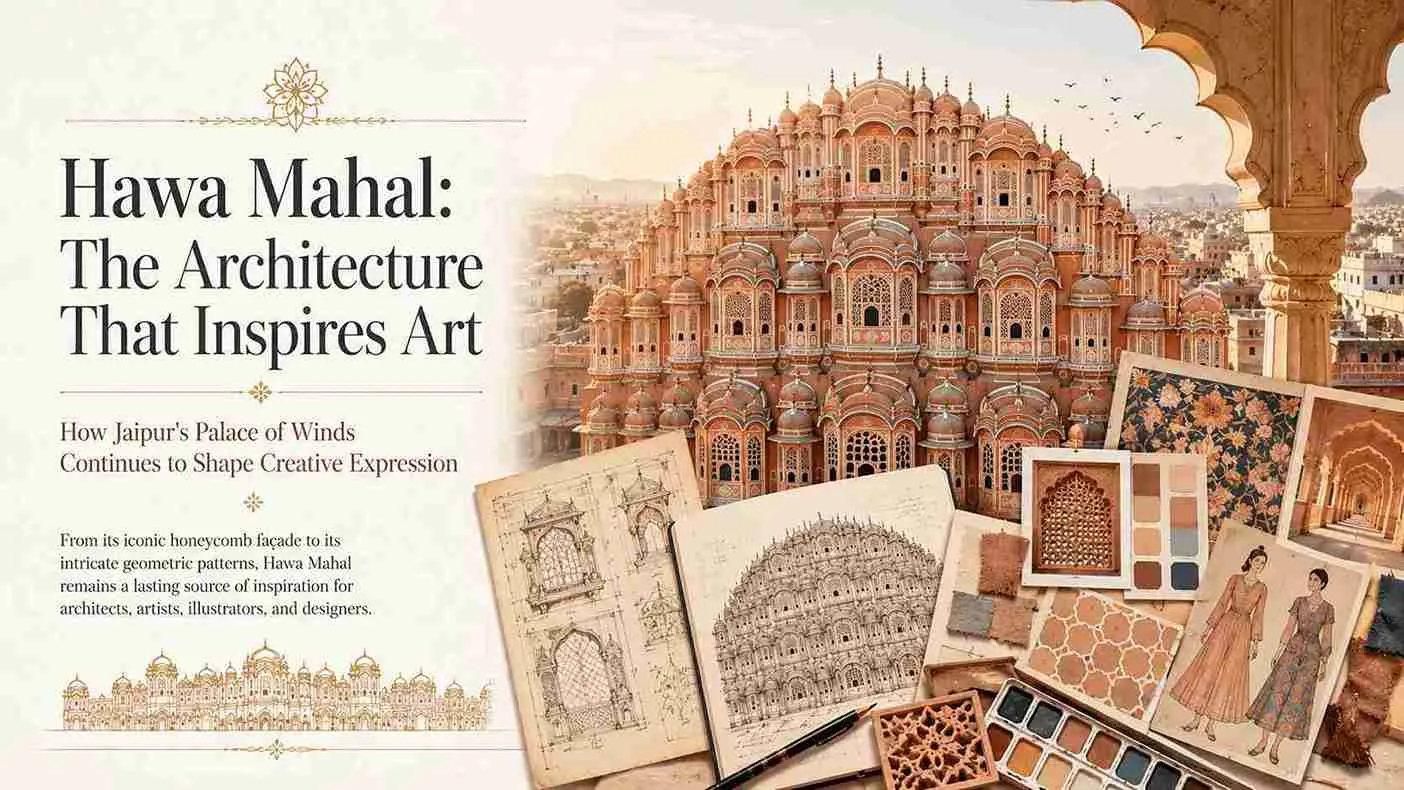
Few buildings capture the imagination of a city quite like Hawa Mahal, the celebrated Palace of Winds that rises over the bustling streets of Jaipur's old quarter. With its delicate pink-and-red sandstone facade and a honeycomb of tiny windows, it is at once a feat of jaipur architecture and a poem written in stone. Travellers pause beneath it, photographers chase its blush at dawn, and artists return to it again and again, drawn by a form that seems to breathe with the city itself.
Yet Hawa Mahal is far more than a postcard silhouette. It is a living reference point for rajasthani design and a quiet muse for contemporary indian art, its lattice screens and crown-like profile echoing through modern interiors, branding, and the work of visual artists across India. To understand Jaipur's visual identity is, in many ways, to understand this single extraordinary structure.
The Story Behind the Palace of Winds
Hawa Mahal was built in 1799 under Maharaja Sawai Pratap Singh, a ruler devoted to the arts and to the deity Krishna. The design is credited to the architect Lal Chand Ustad, who conceived a structure unlike any conventional palace. Rather than a sprawling residence, Hawa Mahal is essentially an elaborate screen-like facade, five storeys tall, fronting onto one of the city's busiest streets.
Its very form carries devotional meaning. The tapering, tiered profile is said to echo the crown of Krishna, a fitting tribute from a king whose faith shaped much of his patronage. This blend of the sacred and the civic is characteristic of Jaipur, a planned city that wove cosmology, symmetry, and royal vision into its streets from its founding.
Purdah, Privacy, and the Royal Gaze
The palace served a deeply practical purpose. The royal women of the court observed purdah, a custom of seclusion from public view. Hawa Mahal allowed them to watch the life of the city below, its processions, markets, and seasonal festivals, without being seen themselves. From behind its screens, an entire world of colour and ceremony could be enjoyed in private.
An Architecture of Light, Air, and the Jharokha
The most famous feature of Hawa Mahal is its facade of 953 small windows, each an intricately carved jharokha, the overhanging latticed balcony-window that is a signature of rajasthani design. Arranged in a dense, honeycomb pattern, these windows transform a flat wall into a shimmering, almost textile-like surface.
The name Hawa Mahal, literally "Palace of Winds," comes from the way these openings function. The perforated jali screens channel cooling breezes through the structure, a form of passive climate control well suited to Rajasthan's heat. Air moves, light filters, and the interior stays comfortable, an early and elegant example of design working in harmony with environment rather than against it.
The Pink City Palette
Hawa Mahal's rosy hue is inseparable from Jaipur's identity as the "Pink City." The warm sandstone tones, ranging from blush to terracotta-red, catch the morning sun in a way that has become emblematic of the city. This palette is now so closely associated with Jaipur that it functions almost as a civic signature, instantly recognisable across the world.
The Logic of the Jali Screen
The jali, or pierced lattice screen, is one of the most enduring contributions of this tradition. It performs several roles at once:
- Filtering light into soft, patterned shade rather than harsh glare.
- Encouraging airflow while maintaining privacy from the street.
- Creating ornament through geometry, so that structure and decoration become one.
- Framing views, turning each opening into a small, composed window onto the world.
This marriage of function and beauty is precisely why the jharokha and jali continue to feel relevant centuries later.
Hawa Mahal's Influence on Jaipur's Contemporary Design
What makes Hawa Mahal remarkable is not only its history but its persistence as a design language. Walk through Jaipur today and you will find its DNA everywhere, reinterpreted by a new generation of architects, designers, and makers who draw on the vocabulary of jaipur architecture without simply copying the past.
Interiors and Built Spaces
Contemporary hotels, boutiques, and homes across the city borrow the jharokha motif and the jali screen as both structural and decorative elements. Carved sandstone or fretwork panels are used to divide rooms, soften light, and add depth. The honeycomb rhythm of Hawa Mahal's facade reappears in screens, headboards, and ceilings, lending modern spaces a sense of place that feels distinctly Jaipuri.
Branding, Craft, and Visual Identity
The palace has become a kind of shorthand for the city in graphic and product design. Its silhouette and lattice patterns surface in:
- Hospitality and tourism branding that wants to signal heritage and warmth.
- Textile and block-print motifs that echo the geometry of the jali.
- Jewellery, stationery, and packaging that adopt the pink palette and arched window forms.
- Wayfinding and architectural detailing in public and commercial spaces.
In each case, the reference is immediately legible. A simple arched, latticed window can evoke the entire spirit of Jaipur.
A Living Muse for Contemporary Indian Art
Beyond design, Hawa Mahal occupies a special place in contemporary indian art. Painters, printmakers, and photographers continue to find new ways to interpret its facade, treating the rows of jharokhas as a ready-made composition of rhythm, repetition, and light.
The genius of Hawa Mahal is that it is already a work of art before any artist arrives. Its surface is a canvas of pattern and shadow, inviting reinterpretation in every medium.
Some artists abstract the honeycomb grid into bold geometric studies; others focus on the play of warm pink against deep shadow, or on a single jharokha framing a fragment of sky. The building bridges the historic and the modern with ease, which is part of why it remains so generative. It offers tradition without nostalgia, structure without rigidity, and a colour story that feels both timeless and fresh.
Why the Motif Endures
The lasting appeal of the jharokha and the lattice lies in their adaptability. They can be ornate or minimal, literal or abstract. For a contemporary artist working in Jaipur or drawing on Rajasthani heritage, these motifs provide a shared visual language, instantly understood yet open to personal expression. That balance between recognition and reinvention is rare, and it keeps the palace of winds at the heart of the city's creative conversation.
Conclusion: A Facade That Keeps Inspiring
More than two centuries after it was built, Hawa Mahal remains Jaipur's most eloquent ambassador. It tells a story of devotion and royal life, of climate-conscious craft, and of a beauty that refuses to date. Its jharokhas still catch the morning light, and its honeycomb facade still teaches designers and artists how ornament and purpose can be one and the same.
To appreciate Hawa Mahal is to appreciate the deeper currents of Rajasthani art, where heritage continually nourishes the new. If the rhythm of its windows or the warmth of its pink stone stirs something in you, that same spirit lives on in the paintings and artworks that carry Jaipur's visual heritage forward, a tradition we are proud to celebrate at RGV Museum.