From Pink City to Modern Art Hub: Evolution of Jaipur's Contemporary Art Scene & Premium Collectibles
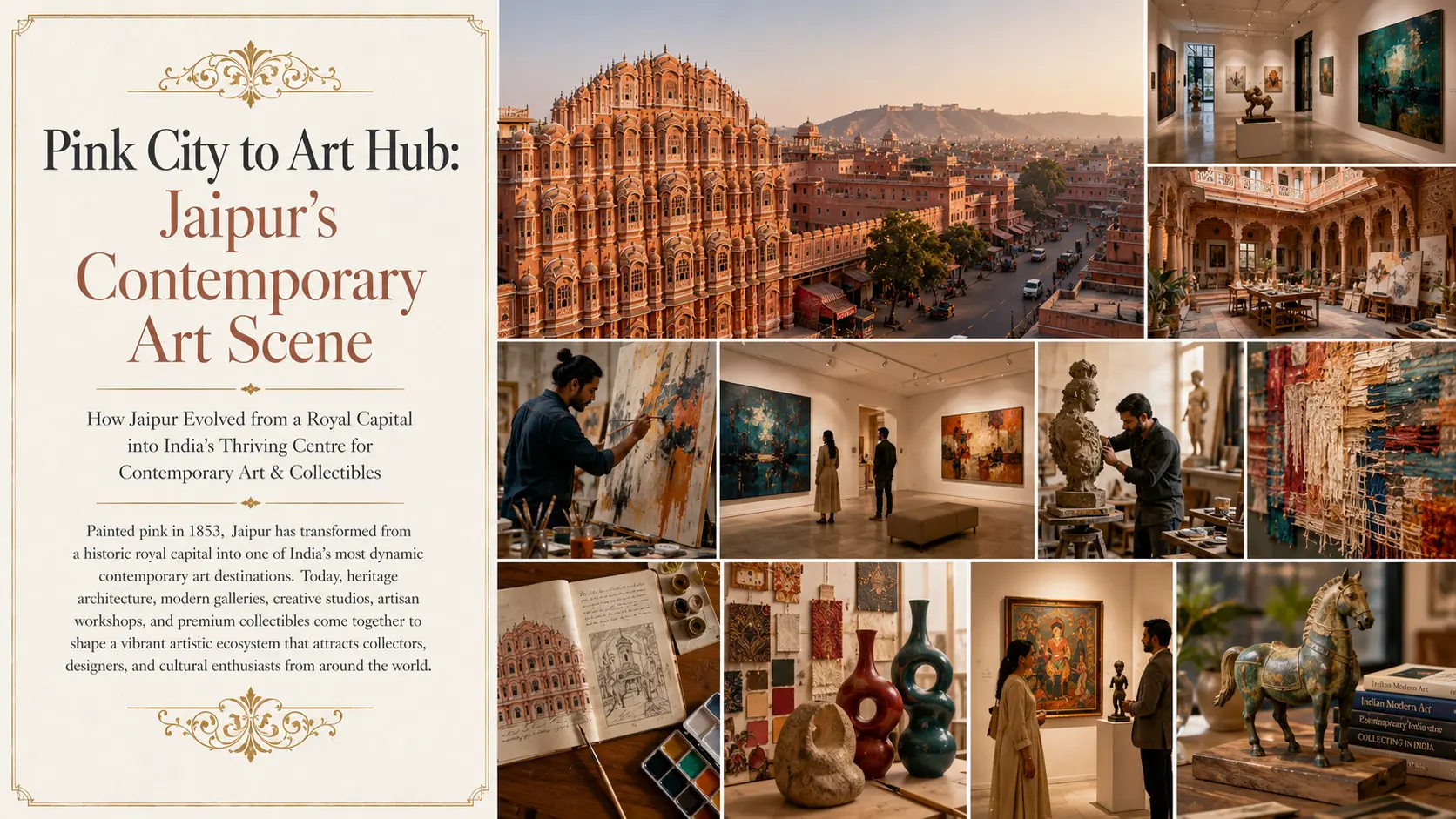
Few cities in India carry their identity as vividly as Jaipur. Painted in warm terracotta hues and crowned by hilltop forts, the capital of Rajasthan has long been celebrated as the Pink City — a name woven into its very walls. Yet beneath that famous rose-tinted facade, the jaipur art scene has been quietly transforming. What was once a city defined by royal patronage and centuries-old craft traditions is now emerging as one of the country's most compelling centres for contemporary Indian art, design, and premium collectibles.
This evolution did not happen overnight. It is the result of a long arc — from the courts of Rajput rulers to the heritage tourism boom, and now to a vibrant ecosystem of galleries, residencies, and a maturing art marketplace. To understand where Jaipur is heading, it helps to trace where it began.
How Jaipur Became the Pink City
The story of Jaipur's signature colour belongs to the 19th century. The city, founded in 1727 and planned according to principles of traditional Indian architecture, was originally a study in stone and sandstone. Its distinctive pink wash is commonly associated with the reign of Sawai Ram Singh II, who is said to have had the buildings of the old walled city painted in a welcoming terracotta-pink shade — a hue often linked to the visit of the Prince of Wales.
Whatever the precise circumstances, the colour endured. It became more than decoration: it became a civic identity, one still protected and maintained within the historic core today. That decision — to give an entire city a unified visual language — was, in a sense, an early act of public art. It set a precedent for Jaipur as a place where aesthetics and daily life are deeply intertwined.
Royal Patronage and the Roots of Rajasthani Craft
Long before galleries and auctions, the engine of Jaipur's creativity was the royal court. Maharajas and noble families sustained generations of artisans, and this patronage produced a remarkable depth of skill across many disciplines. The legacy of that era is still visible in the workshops and bazaars of the city.
Among the traditions nurtured under royal support were:
- Miniature painting — intricate works on paper depicting courtly life, mythology, and nature, executed with extraordinary fineness.
- Blue pottery — a distinctive glazed ceramic craft that remains closely associated with Jaipur.
- Block printing and textiles — hand-carved wooden blocks used to pattern cloth, a practice still thriving in nearby villages.
- Gemstone craft and jewellery — the cutting, setting, and enamelling skills that made the city a centre of the trade.
- Fresco and architectural ornament — the painted surfaces of palaces and havelis that gave interiors their richness.
These crafts were never static. Artisans absorbed new influences, adapted to changing tastes, and passed techniques down through families. That continuity of skill is precisely what gives today's modern art jaipur practitioners such a distinctive foundation to build upon.
From Heritage Tourism to a Living Art Hub
For much of the late 20th century, Jaipur's creative reputation rested largely on heritage. Visitors came for the forts, the palaces, and the romance of the pink city, and craft was something to be admired and purchased as a souvenir. That tourism boom was important — it kept traditional skills economically viable — but it also risked freezing the city's art in the past.
The shift toward a genuinely contemporary culture has been gradual and organic. As designers, artists, and entrepreneurs returned to or settled in Jaipur, the city began to develop the infrastructure of a modern art centre rather than only a heritage destination.
New Spaces and New Conversations
Today the city hosts a growing constellation of art-forward venues: independent galleries showing contemporary indian art, design studios reinterpreting traditional motifs, artist residencies that draw talent from across the country and abroad, and a wave of art-conscious cafes and concept stores that double as informal exhibition spaces. Jaipur's broader cultural calendar — known internationally for its literature and arts gatherings — has also helped position the city as a place where ideas circulate, not just objects.
Heritage as Raw Material
What makes the contemporary scene here distinctive is its relationship to the past. Rather than rejecting tradition, many Jaipur-based artists treat it as raw material. A miniaturist's discipline might inform a large-scale abstract canvas; the colour palette of frescoes might reappear in digital work; block-print geometry might be reimagined in sculpture. This dialogue between old and new is the city's creative signature.
In Jaipur, heritage is not a museum behind glass — it is a living vocabulary that contemporary artists continue to speak in new accents.
The Rise of the Art Marketplace and Premium Collectibles
Alongside this creative flourishing, the commercial side of the art world has matured. A serious art marketplace has taken shape — one that connects regional talent and traditional masterworks with collectors who may live far from Rajasthan. This is perhaps the most significant change of all, because it gives artists sustainable ways to work and gives collectors structured ways to discover and acquire.
The category of premium collectibles in this context is broad. It spans fine paintings and works on paper, limited editions, finely crafted decorative objects, and pieces by both established and emerging names. For many buyers, the appeal lies in owning something with genuine cultural lineage — an object that carries a story.
Why Online Auctions Matter
The growth of online platforms and curated auctions has been transformative. Collecting is no longer limited to those who can walk into a gallery in person. Digital art marketplaces and auction formats have widened access in several practical ways:
- Reach — collectors anywhere can follow, bid on, and acquire work rooted in the Jaipur tradition.
- Transparency — clear listings, provenance details, and auction records help buyers make informed decisions.
- Discovery — emerging artists gain visibility they might never have found through physical channels alone.
- Convenience — the practical barriers of distance and timing are greatly reduced.
For a platform devoted to Indian and Rajasthani work, this digital shift is an opportunity to honour heritage while serving a modern, connected audience.
Indian Art as Passion and Investment
For collectors, Jaipur's evolution raises an appealing question: is acquiring Indian art a matter of passion, or of investment? The honest answer is that it can be both, provided one approaches it with care.
Art should first be collected for love — for the way a work moves you, fits your life, and deepens over years of living with it. At the same time, a thoughtfully assembled collection of quality contemporary indian art and traditional masterworks can hold and grow in cultural and financial value, particularly as interest in the region continues to rise. A few principles tend to serve new collectors well:
- Buy what genuinely resonates with you, not only what is fashionable.
- Pay attention to provenance, condition, and authenticity.
- Learn the lineage — understanding an artist's roots enriches both enjoyment and judgement.
- Think in terms of years and decades, not quick returns.
Conclusion: A City Still Painting Its Future
Jaipur's journey from a sandstone capital washed in welcoming pink to a dynamic centre of contemporary creativity is a reminder that great art cities are never finished. The same instinct that once gave the pink city its colour now drives a new generation of artists, gallerists, and collectors who are redefining what Rajasthani art can be — confident in its heritage, yet entirely of the present.
For anyone drawn to this remarkable arc, there has rarely been a better moment to look more closely at Indian and Rajasthani art — whether as a curious admirer or a committed collector. Institutions and platforms dedicated to the region, such as RGV Museum, exist precisely to make that exploration richer and more rewarding. Wherever you begin, may you find a work that speaks to you — and a story worth carrying home.